Sunday, October 31, 2010

Ghana 2010 Census

It’s been pretty quiet the past two weeks.  No lost earring.  We have been busy, however; there is just nothing exciting to report.  So what can I say about another two weeks in Ghana?


This is the flag of Ghana.  If you ask a bunch of Ghanaians there is general agreement that the red is to represent the blood shed by those who fought against colonial rule, the yellow is to represent the abundant natural resources (gold) of the land, and the green is to represent the country’s rich vegetation.  There is disagreement what the black star is to stand for.  According to the official Ghana website, GhanaWeb.com, “the five pointed lone star . . . is the symbol of African emancipation and unity in the struggle against colonialism.”  (This is a quote from Mrs. Theodosia Salome Okoh, who designed the flag.  She is the Betsy Ross of Ghana.)   In a couple of paragraphs I will give you my interpretation of the colors and the black star.

Let me share two Ghana experiences that were new to us.   Because we’ve lived here ten months one would think that we have seen it all.  But that’s not the case.  These two experiences made us pause and say, “Wow, that’s new!”  

The first experience occurred two weeks ago on Sunday.  As we were driving down Burma Camp Road to church we heard a loud siren.  Sirens are common here but they are not the usual stop-everything-look-around-hold-your-ears sirens like they are at home.  They are less annoying.  And most of the time ignored.  But this one on Sunday sounded like it meant business.  As we looked toward the approaching sound we could see cars moving out of the way and then we visualized an honest to goodness fire truck coming towards us.  It was a hook and ladder fire truck, the kind with a driver in front, a long center and then a second driver at the rear.  We were amazed.  Amazed to see such a modern vehicle here in Accra.  And amazed because the fire truck appeared to be actually responding to a fire.   We both immediately questioned to which fire was this truck responding?  There is always smoke in Accra.  Always.  You can’t go anywhere without seeing a pile of something on fire.  We discussed the difficulty these firemen were going to have if they would be looking for smoke to determine the location of the fire.     

The second experience occurred this past week.  It was very gratifying.  It was so gratifying that I wanted to get out of the car and congratulate the participants.  It happened at the Tetteh Quarshie Circle.  (The only true cloverleaf exchange in Accra.)   Marsha and I had been in Tema and decided to stop at the Accra Mall on the way home and get groceries.  We were heading west on the Tema highway and took the offramp at the Tetteh Quarshie Circle to head south on Independence Road.  We then took the offramp to head east on the Tema highway.  This turned us toward the mall exit.  We then maneuvered into the right hand lane to take the offramp to the mall.  The offramp for the mall is a double lane.  The traffic was moving very slowly.  In true Ghanaian driving fashion the two proper lanes of exit traffic had been doubled to four lanes with a lane on the shoulder of the road (on our right) and a lane hugging the two center lanes (on our left) creating four lanes trying to squeeze into two lanes.  This is not a big deal.  Four lanes crowding into two lanes actually works most of the time without a lot of driver consternation.  The problem was the fifth and sixth lanes of taxis to our left who would bypass the proper lanes of traffic, drive to the head of the congestion and then try to squeeze in at the last moment.  The fifth and sixth lanes made for extremely crowded and slow moving traffic.  As we approached the actual exit with the six lanes of bunched up cars we noticed that there were traffic police standing at the offramp.    They were actually stopping the taxis in lanes five and six and making them get out of the added lanes and continue straight on the highway.  Most of the taxis stayed in the added lanes thinking that the police would eventually look away and they would still be able to continue and squeeze in.  But the police stood their ground, and yelled, and pounded on the car hoods, and made all of the drivers move on.  I wanted to jump out and thank the police.  It is the first time that we have actually seen traffic rules enforced. 


I forgot to mention in my last blog entry that Marsha and I participated in the Ghana 2010 Census.   A census taker knocked on our door about 7:00 p.m. three weeks ago and asked us to participate in the census.  He had an official shirt, an official ID badge, and an official notebook with the census questions.  We invited him into our living room and sat with him as he asked us 14 pages of questions.  He spent about 45 minutes with us.  He was very polite.  He spoke all of the local languages, English and French.  He recorded most of our responses by writing them out longhand.  He did not appear to have a computer friendly response sheet such as one with circles that can be filled in with a number 2 pencil and then read with a scanning machine.  There were a few questions where we had multiple answers to choose from and he would pencil the number of the choice into blank boxes.  I imagine there will be a large contingency of workers who will transcribe the answers into a data entry type format for computers to summarize the results. 

Most of the questions were standard census questions:  when and where were you born, how long have you lived at this address, what is the level of your education, are your married, are your parents alive, what are the ages of your children, what is your occupation?  Etc.   The last two pages focused on the dwelling in which the responders lived.  The census taker was kind enough to let me make of copy of those two pages.  There were 15 questions.  I have scanned these two pages and posted them here but they are not readable.  Click on the photos to enlarge them.  


Here are some of the questions.  What is the main material of the outer walls of this dwelling?  (Answers include mud bricks/earth, wood, metal sheet/slate/asbestos, bamboo, palm leaves.)  How many rooms does this household occupy?  Specify.  (Count living, dining, bedrooms but not bathrooms, toilet & kitchen.)   How many of the rooms are used for sleeping?  Specify.  Does the household share this sleeping room with other households.?  Yes or no?  What is the main source of drinking water for the household?  (Answers include pipe-borne inside dwelling, pipe-borne outside dwelling, public tap, protected well, rain water, tanker supply, river/stream, pond/lake/dam/canal.)  What is the main source of cooking fuel for this household?  (Answers include none/no cooking, wood, gas, electricity, kerosene, charcoal, crop residue, saw dust, animal waste.)  What type of toilet facility is usually used by the household?  (Answers include no facility, W.C. [water closet = toilet], pit latrine, KVIP [I don’t know what this is], bucket/pan, public toilet.)   Do you share this toilet facility with other households? 

Ponder these questions, for a while, if you ever find yourself thinking your house just isn’t quite as nice as you think it should be.     

Back to the flag.  Here is my explanation of the colors and the black star.  I’m sure Mrs. Okoh was inspired to choose the three colors of red, yellow and green for the original Ghana flag.   But I’m convinced after driving in Ghana for the past ten months that red, yellow, and green do not stand for the blood, gold and vegetation of Ghana.  I think the colors stand for three major cellular phone providers who are determined to paint everything in Ghana red, yellow, or green.  This first picture is an example of the red/yellow/green cell phone “kiosks” that are everywhere.  
These kiosks handle all of the day to day business of the cell phone owners.  


The second picture is a little blurred but you can see all of the colors of the flag in this one picture.  Note, also, the unfortunate style of wearing pants demonstrated by the young man talking to the vendor.  I think you can see the same three colors in his underwear.


The next three pictures show examples of the advertising.  The red is Vodaphone, the yellow is MTN, and the green is Glo.  Advertisements for these three providers are everywhere.  

Vodafone
MTN
GLO
It is not an exaggeration to say, when driving through any part of Ghana, either in the cities or in the villages, that a majority of the buildings are painted red, yellow, or green.  A lot of paint representing the colors of the flag has been spread around Ghana.  OK.  So what does the black star stand for?  Many Ghanaians say it stands for the Ghana football team (that beat the USA in the last World Cup.)  Mark Stubbs told us that it stands for the potholes of Ghana.  I tend to agree with Mark. 

Here’s a picture I took while driving through Adabraka.  Click on it to enlarge it and look at the line "Dealers in: . . . . . "

I can understand the general water pumps, and the water filters, but I just don’t know what they are offering when they advertise “lawn movers.”   Do customers actually come in and request machines to move lawns?  Somebody obviously didn't edit this business banner before printing it.  

Here’s another photo taken during our travels. 

In driving around Accra it is not uncommon to see buildings with instructions hand painted on the outside  “remove before ___date___ by order of the AMA [Accra municipal authority].”    There are obviously no zoning laws and no permits required in Ghana to start a roadside business.  Anyone can put up a shack and start selling.  But there seems to be a heavy handed government authority that drives around and tells certain businesses to disappear (the ones that probably haven’t paid the appropriate bribes.)  The instruction in this photograph is unique.  Does the municipal authority really want this fence to be removed?    

I have described before the fruit that is so abundant and inexpensive.  Here are some photos of our favorite fruit stand.
Ruth
Paulina

Ruth owns and/or runs the fruit stand with her sister Paulina.  We love both of them.   It is hard to believe this but Ruth indicates that the best of the fruit season is yet to come.  I’ll take her word for it but I don't feel we are currently in a fruit famine.  We have been without mangos since June but Ruth says they will be back by December.  Here are pictures of fruit in abundance.  The first is a picture of bananas on the tree. 

The second is a picture of papayas almost ready for harvest.

By the way papayas are spelled paw-paws and pronounced po-pos.  We enjoy a po-po every day.  And here is a picture of a mango tree with immature fruit.

We can’t wait until December until the mangos come into season. 


Last item:  hubcaps are a big item here.  Most of the cars on the road have hubcaps instead of sport wheels.  
Car with hubcaps
Car without hubcaps

Some of the hubcaps are pretty fancy like this one which reminds me of the axle cutting blades seen in the famous Ben Hur chariot race between Charlston Heston (driving the white horses) and the bad Roman guy (driving the black horses.)   The blades were intended to cut through the opponent’s wheels.  I hope they don’t have the same function here in Ghana.   Here’s another picture to demonstrate just how big the hubcap business is. 


So now I’m going to share a photo of something that has piqued my curiosity for weeks. 

What is it that I can see on this hubcap?  Well, with close inspection it is nothing more than another Practical Solution to Make Living in Ghana Easier (remember the new list I started two blogs ago with the method of drying zip lock bags?)    This is another example of Ghanaian ingenuity.  It is a wire tire holding the hubcap onto the rim.  It is much easier to see upon close inspection.   
Note the wire tie
 (It was pretty tough getting this close up picture of the hubcap being held on with a wire tie.  I had to hang out my car door to take the photo.  I'm sure the onlookers thought it was normal behavior for a white person to hang out his car door inspecting the wheel of a parked car.)   So, just like the zip lock bag solution keep in mind this remedy when you have trouble keeping your hubcaps on.  (Can you imagine the racket that occurs when a hub cap comes off a wheel turning at high rpm and the hub cap is held onto the rim with a single plastic wire tie?)


In celebration of November election week  I will close with this photo which, undoubtedly, was inspired by President Obama’s visit last year to Ghana. 


Don’t forget to vote on Tuesday.  

Saturday, October 16, 2010

The Lost Earring

I had intended to post a blog entry last Saturday but instead spent the day, with Marsha, retrieving a lost earring.  Here’s what happened.  (If this starts sounding like a BORING travelogue just skip ahead to the update on the Ghana Tomato Project.)

On Tuesday of last week (5 Oct) Marsha and I and three other missionary couples drove to the Volta Region.  This is the part of eastern Ghana where the Volta River was dammed in the 1960’s creating the world’s largest man made lake (reservoir.)  The area around the lake is beautiful with rolling hills, lush vegetation, and innumerable Kodak Moment villages.  It is about a two hour drive from Accra to the region of the dam and reservoir.  Before checking into the Volta Hotel we took a boat ride on the Volta River.  
Note the earrings
When your driveway is a river
After the ride we checked in to the hotel and spent the remaining hour of daylight walking the hotel grounds.  The Volta Hotel overlooks the dam. 
The dam is an earth/rock/concrete dam similar to the dam at Lucky Peak Reservoir.

On Wednesday morning we drove to Tafi Atome, about a two and a half hour drive from the hotel up the east side of the reservoir.  This is the road to Tafi Atome.  


Tafi Atome is the location of a government protected monkey preserve.  The Ghana guide book calls it a monkey sanctuary.  There are four bands of mona (species) monkeys in the preserve.  Each band contains about 90 monkeys.  The monkeys have been protected by law for about 15 years and the community has used this protection as a tourist attraction to generate compensation for the lost income of not being able to hunt/kill the monkeys.  After payment of an entrance fee the guide takes you on a trail into the preserve and starts “calling” in the monkeys.  It doesn’t take very long.  (Pavlov would be proud of this training.  The guide makes a whistling noise and the monkeys come swinging through the trees.  I’m sure they salivate when they hear the whistling.)  
The monkeys are very polite.  You hold a banana in your hand with about an inch of it exposed.  The monkeys will peal the banana for that inch and eat it.  You then push up another inch of the banana and the monkey will peal and eat.  You repeat the process until the banana is gone.  If you stand too far from the monkeys for them to reach down from the branches and get the bananas the bold ones will actually jump onto your arm and eat while sitting on your arm.  
We were all feeding bananas in turn, and taking photographs.   When it came to Marsha’s turn she held her banana expecting a monkey to politely jump onto her arm and eat.  Instead two monkeys from behind us, and from quite a distance up in the trees, jumped onto her head.  Simultaneous with Marsha starting to scream the guide told her to hold still and not panic.  The monkeys quickly went from her head down to her hand and ate the banana.     
Note the missing earring
We spent about 30 minutes feeding the monkeys and walking out of the jungle.  We then spent another 30 minutes at the “gift shop” and visiting with the children at the school adjacent to the monkey preserve.  We left Tafi Atome and drove to Wli Falls and hiked into the falls.  (I have described the falls before.  See the blog entry dated 19 June 2010.)  In the car on our way back from the falls to the hotel Marsha noted her left earring was missing.  We tried to reconstruct the day to think of where she might have lost it.  She was upset because she had brought very few earrings to Ghana and these were her favorite ones.  And the most expensive ones.  We searched the car.  We asked among the missionary couples.  We all concluded that she probably lost the earring at the time she had the monkeys on her head.   At dinner that night we all sat around the table and joked about monkeys that were thieves.  We envisioned monkeys sitting around on the branches planning their earring attacks – distract the humans by eating bananas and then steal the bright earrings.   We concluded that they must be adolescent gang members.  Probably the Mona Earring Gang.  We could possibly find the thief if we had all the monkeys stand in a police line up and looked for the “pirate” monkey wearing one earring.  Maybe he would have a patch over one eye.  We all laughed about it except Marsha.

We returned to Accra on Thursday.  On Friday we looked at the pictures of our trip and made a startling discovery.  Can you see the earring in this picture of the monkeys?  You might need to click on the picture and enlarge it.
The earring is visible in the jungle soil.  After discovering this Marsha immediately called the guide and explained the loss of her earring along the trail.  She asked him to go out onto the trail where we had been three days earlier and look for the earring.  We both thought that the request would probably be ignored.  But the guide called back in less than ten minutes and indicated he had found the earring.  We told him we would be there on Saturday.  We drove up to Tafi Atome on Saturday and gratefully retrieved the earring.  We returned to Accra pleased with the success of the trip.  Marsha had her favorite earrings.  And we had experienced another incident demonstrating the goodness of the Ghanaian people. 

I mentioned this incident to the doctors and nurses at Korle Bu when I was there two days ago.  I was surprised that most of them had not heard of the monkey preserve.  But then Ghanaians probably don’t read guide books on Ghana.   And most of them don’t have the means to make an eight hour trip for a purely recreational activity.  And why would a Ghanaian travel such a distance to see something he or she has been raised with?   How many Idahoans would make an eight hour round trip to see horses in a horse preserve?   Anyway, the doctors and nurses seemed interested in hearing about our experience at the preserve.  I described how the monkeys would delicately peel and eat the bananas held out to them.  And I demonstrated how one could hold out one’s arm and the monkeys would jump onto the arm and eat the banana.  I described how Marsha is petite with blond hair and how the monkeys surprisingly jumped from the trees onto her head.   I jokingly said “she must have looked like a large banana.”  Everyone started laughing and wouldn’t stop.  I was surprised.  I didn’t think it was funny enough to double over with laughter.  One of them asked if I had actually described my wife as looking like a banana.  I said “yes.”  And they laughed again.  Obviously I must have hit their banana funny bone.  Or maybe describing someone as a banana is the ultimate Ghanaian slur, equivalent to perhaps describing someone as a potato in America, and they couldn’t believe this American doctor would describe his wife in such terms.  They laughed until some of them had tears.   Here is a picture of the exam room where I was standing when I uttered this killer line. 

It’s time to update the Ghana Tomato Project.  I currently have two tomato plants alive, Mercy (kind of) and Hope.  As you recall Justice (American seed) died early before it had produced a single blossom.  Mercy (American seed) produced a plethora (I love that word) of blossoms.  I last reported my frustration with Mercy producing lots of blossoms but only one fruit.
Mercy three weeks ago

I also described how tomato plant #3, Charity (dried seed from a Ghana tomato) had fewer blossoms but early fruit.
Charity three weeks ago

Justice was replaced with Hope from the dried seed of a Ghana tomato.  

Here is a current picture of Hope.  
Hope

There are three blossoms that opened this week.  We have performed our manual pollination ritual for these blossoms “hoping” for a bounteous harvest.

About three weeks ago we harvested the single tomato from Mercy and loved it.  It was probably the best tasting tomato we’ve had here in Ghana.  We were disappointed that Charity, despite quickly forming a tomato on its first blossoms, produced only one tomato.  We were more than disappointed when we harvested it.  It was tasteless.  It was worse than tasteless.  We couldn’t finish eating it.   I removed Charity and have not replaced it. 

At the time I removed Charity I was ready to remove Mercy but noticed two small tomatoes forming.  So I left Mercy in her pot with two green tomatoes that have been on the vine for three weeks now but haven’t hinted at turning red.  I question whether Mercy is alive enough to promote the final maturation.  
Mercy today
It is all down to Hope, now.  When I last described the tomato project I indicated that if Hope does not prove to be bounteous I’m going to replace her with a shrub.  It appears that nature heard my threat.  Notice in this picture the growth of leaves coming from the home made tomato cage supporting Hope. 
Hope
One of the dead branches I used to make the cage is now sprouting branches and leaves.  It is growing very well.  So, if I have to give up Hope I’ll have my shrub already in place and thriving. 

I want to share another endearing Ghanaian phrase.  Actually it isn’t a phrase but two terms of affection we frequently hear.  Many Ghanaians we come into contact with refer to me as “Daddy”  (pronounced “daaw-dee”, equal emphasis on syllables) and to Marsha as “Mom” (pronounced  “mum.”)    Ebenezer Otoo in the office never calls me on the phone without beginning his conversation with “how’s Mom.”  The guards at the apartment greet Marsha with “good morning, Mom.”  The beggars on the street will greet us with Daddy and Mom.  The checkers in the store will similarly greet us.  The Ghanaian missionaries frequently call us the same. 

We were with President and Sister Froerer on Thursday and drove to a little crafts market called the Wild Gecko.  Marsha and I have been there enough times that the employees recognize us.  I have come to know one of the employees Mary by name and always chat with her when there.  As President Froerer and I walked around the periphery of the store we encountered Mary.  I greeted her.  She replied with “hello, Daddy.”  We exchanged pleasantries.  President Froerer then asked her that if I were Daddy what would he be?   She politely replied “Grandpa.”  He was not amused.  

I have described the insane motorcyclists before.  They are reckless.  Shortly after we arrived in Ghana and had experienced the motorcyclists I told Marsha that some time during our stay here we would witness a motorcycle accident.  Two days ago I came upon a motorcycle accident shortly after it happened.  Fortunately, Marsha was not with me.   It was at a busy intersection.  It was gruesome with two riders obviously dead and a motorcycle spread out in pieces along twenty meters of the road.   I did not stop.  There was no medical assistance I could have rendered.  And we have been emphatically told that if we get involved in such accidents that we will be caught in a situation where we might become financially responsible for the damages and the burial of the victims. 

I wish the government would crack down on the reckless motorcycle drivers.  The drivers of all sizes of motorcycles, from scooters to large road bikes, who frequently do not have helmets, who go through intersections without stopping, who weave in and out of lanes of traffic, who drive on sidewalks and who drive into the oncoming lanes of traffic until the very last moment and then dart back into the proper lane.  They are dangerous, to themselves and to the drivers of motorized vehicles who are always having to watch out for the motorcyclists.  There needs to be a tough government campaign to modify this method of travel.  At least make them wear helmets and obey traffic signs/signals.  And while they are at it the government needs to have a tough campaign to stop public urination.  It is disgusting.  When we were coming back from retrieving Marsha’s earring on Saturday we passed a tro-tro stopped along the side of the road and all of the passengers, both men and women (there must have been a dozen), were off the side of the road urinating.  Interesting rest stop.  I’ve become accustomed to a lot of disturbing images here in Ghana but public urination is not one of them.  And there needs to be a campaign against littering.  And there needs to be a campaign against . . . . . .

Yikes, you’d think I’m upset.  I am.  Last night we were almost to our apartment on a two lane residential road and we had a tro-tro come at us in our lane expecting us to move over.  There was not a place for me to move to so we came to a standstill facing each other.  He was motioning us to move out of his way.   I was wanting to give him an American hand signal frequently used in such situations but because I’m a missionary I didn’t.  We sat there waiting, staring each other down until his lane of traffic started moving and he could pull into it.  Idiot drivers.   I was upset all evening.

This has been a hasty blog entry.  Sorry.  We will be very busy next week and if I don’t get something posted today it will be another seven days.  Another week would be too much time between posts.  I have so many things I want to describe.  I need to find time to get to them.  I need to explain how the journalists for the three major newspapers here in Ghana must have attended the National Enquirer School of Journalism.  I need to give tribute to Dr. Seuss with White Eggs and Ham.  I need to get together my pictures for a  Gates of Ghana photo essay.  I need to do an entry on automobiles, hubcaps and wire ties.  And I’ve finally discovered why the internet is so slow.  It’s the palm trees.  Oh, so many topics and so little time.   By the way, we are now on the downhill side of our time here in Ghana.  But who’s counting?

Closing item.  I’ve had some inquiries about the Elle & Vire French Butter thermometer I described in my last entry.   Here is a close up photo of what you need to purchase if you are interested in acquiring a French butter thermometer.  You can choose salted or unsalted.
And here is a photo of my thermometer in action this past week.

It is easy to read the temperature.  It is Hot degrees approaching Really Hot.  (The butter has lost its shape and starting to form the yellow oil of Really Hot degrees.)  No sweat yet on the counter top. 

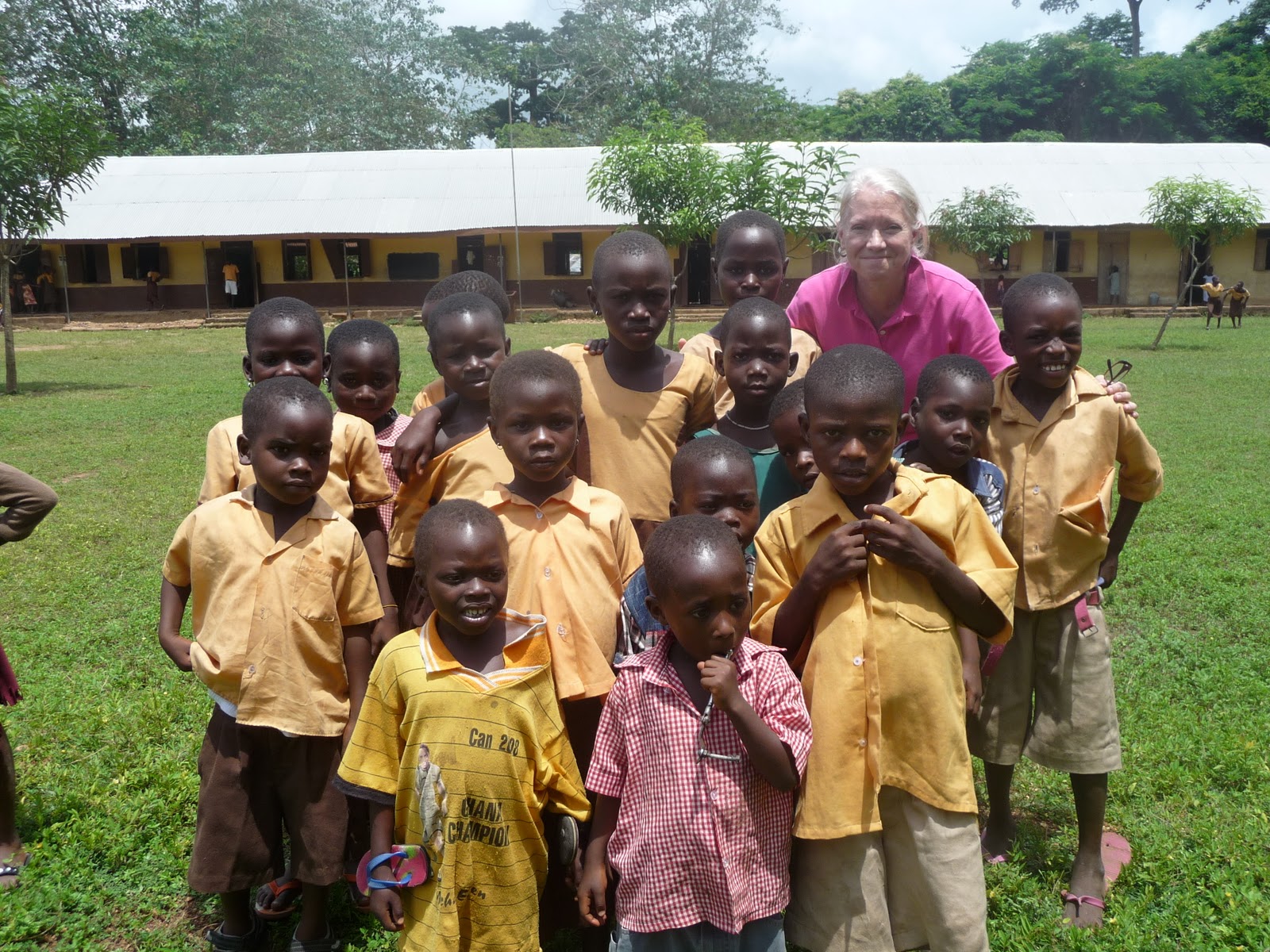
Here are some closing photos of the beautiful children of Ghana.  There is no need for a government campaign promoting beautiful children in this country.  They are all beautiful. 


Students at Tafi Atome


Sunday, September 26, 2010

Saturday 25 Sep 2010

This is a mid day photo of the fishing boats off the beach of Jamestown in downtown Accra.  The fishermen have been out for the morning, have returned, and have anchored their boats for the day.

This is a street vendor selling the morning’s catch. 


I was wrong.  I reported in my 28 August 2010 blog posting that the bats were back.  They were here for only three days/nights and then they left.  Obviously, something wasn’t right for them.  I noticed on their first day that they were darting in and out of the trees but not landing.  Perhaps the dense vegetation of the rainy season has made it difficult for them to secure hanging places on the branches.   We’ll keep watching for them.

We have had some of our most beautiful weather the past three weeks.  The morning mist has diminished.  The temperatures have been truly tropical, 80 - 85 degrees each day.  The breezes have been refreshing.  And the sky has been blue, not the gray that was so discouraging our first few months here.  It is slowly getting warmer.    

A week ago I stood next to Daniel Kabason, one of the Ghanaian office employees, in the lobby and told him how much I was enjoying this beautiful September weather.  He didn’t seem to think that my excitement warranted a response, which is not surprising as I have found most Africans have little interest in the weather, but he must have felt obligated to try and make small talk so he asked “What is September weather like where you come from?”  Well, I wasn’t going to let that question go unanswered.  Americans are always interested in the weather.  I started into the excitement of September in the Rocky Mountains describing with great animation how the leaves of the trees were changing colors, the night time temperatures were cooling, the day time warmth was waning, and the breezes were hinting of coming winter.  I told him that the best way to describe the weather was “crisp.”  He looked at me for a moment, obviously trying to understand my animated description, and slowly asked “What do you mean by crisp?”  I didn’t have an answer for him.  How does one explain “crisp” to someone who has never been out of 95% humidity?  Crisp doesn’t happen here in West Africa.  Soggy does, but not crisp. 

In that same 28 August blog posting I commented on our neighbor’s tree that dropped all of its leaves in a three day period.  I posted a picture showing the bare branches.  This next picture, taken two weeks later, shows the same tree in full foliage.  

Note all of the leaves.  I vaguely remember something from biology that in the fall when the temperatures start cooling the sap (nutrition) of the tree pulls back from the branches toward the trunk which results in the falling of the leaves, and then after a dormant winter and the warming of the temperatures the sap moves back out to the branches bringing nutrition for the new leaves.   It is amazing that this tree in Africa has adapted to the environment in that its fall/winter cycle is just two weeks. 

I mentioned that the temperatures are warming.  In the past two weeks the pleasant afternoons have become hot.  Our drive home from the office to the apartment is sticky again.  The night time temperatures require keeping the bedroom air conditioner running.   I need to share an observation I have made about the difficulty of determining the temperature in Ghana.  You are probably asking yourself why is he even bringing up such a simple task?   Everyone knows that when you want to determine the temperature you simply look at a thermometer. Or you check the temperature gauge on the dashboard in your car.  Or you look at a bank reader board.  Or you watch/listen to the weatherman on the morning/evening news.   Or you glance at your wrist watch if it is one of those fancy ones that tells time and in addition does everything else we were taught to do in elementary school (like add, subtract, calculate interest, list the time zones of the world, determine latitude and longitude, and give the current temperature.)   Well, it’s not quite that easy here in Accra.  First, there are very few thermometers.  You can’t find them for sale in stores.  I have not seen one available for sale on the street.  We do not have a temperature gauge in our car.  I have concluded, based upon this astute observation, that thermometers are available for sale only in places where there is a fluctuation in temperature.  In such places it is wise to have a thermometer to determine, when you look out the window in the morning, if it is appropriate to wear your coat or your swimming suit.  No such need in Ghana.   After nine months here, including the “cooler” months of the rainy season, I can assure you that a swimming suit could easily be appropriate attire for the expected temperature of the day.  That easily explains the lack of availability of thermometers for sale.  Not much of a buyers’ market here.  There are no reader boards on the banks.  In addition to not letting you know what the stock market is doing the banks are obviously not interested in letting you know how hot it is outside.  I have yet to see a weather report on the local TV stations, but I must admit that I have not watched the local stations enough to know if there is such a thing as a weatherman.  And I do not have a fancy watch that tells me the current temperature.  So, what is a guy to do if he wants to know just exactly how hot it is?  Let me tell you my current method.  I have carefully and scientifically researched this and can vouch for its accuracy.  It is called the Elle & Vire French Butter Thermometer method of determining the temperature.  This photo shows my thermometer in action. 

Here is how the thermometer works.  Leave the Elle & Vire French Butter out of the refrigerator in a bowel.  If after an appropriate time, such as an hour, it is soft but still formed it is Comfortable degrees.  If the butter is soft but has lost its shape then it is Hot degrees.  If it is liquid and has the appearance of yellow oil then it is Really Hot degrees.  You know it is Miserably Hot degrees when you lean over to check the butter, you see that it is yellow oil, and the sweat off your face drops onto the countertop.  I have found this method of telling the temperature very accurate.  The above photo clearly demonstrates that it is Comfortable approaching Hot.  And, by the way, in researching this method I have also come to appreciate the wonderful taste of French butter (without the sweat.)  The French really do know how to make their butter.  And how to use it.  For more than thermometers.   (Didn’t Julia Child once say that if what you are cooking doesn’t taste right simply add more butter?  French butter.  If she didn’t say that I’m sure she thought it.)  When we leave Ghana one of the things I will miss the most is the wonderful French butter – for cooking, that is.  I won’t need it as a thermometer.  I will also miss the Ghanaian industrial strength toilets.  But, I don’t think I will talk about them here.  That is a topic for another blog posting. 

I have discovered another item to add to the LGU (List of Ghana Unexplainables.)  This is a statue with an associated word display located on the road along the ocean from downtown Accra toward Korle Bu.  This is a picture of it.


I have asked four Ghanaians to explain the statue and display and none of them can do it.  Two doctors at Korle Bu called it the “dog” statue.   They were standing together when I asked about the statue.  They both laughed when I called it the “golden calf” statue.  They said it was not a calf, but a dog.  It often has a scarf around its neck.  Both of them thought it had been built by descendents of the Ga tribe who were the original inhabitants of Accra.  They thought that the statue had some religious significance but did not know any details. They had no idea what the scarf means.  And neither of them could tell me what the word display means.  It is in a language neither of them can read.  The other two Ghanaians I asked did not have an explanation either.  So, unless someone reading this blog can give me an explanation I am putting this item on the LGU.

Speaking of lists I have been considering, for a while, to start a new list of Ghana experiences, something along the line of Practical Lessons Learned in Ghana that Make Living Here Easier.  (I definitely need a better name than that.)   Anyone who has lived here will immediately understand.   Examples on the list include:  always take a cooler when you go to the store or any item that is cold, such as French butter, is not cold when you get home, do not try to peel a mango (I’ll explain in a future blog posting), and, despite wanting to be a courteous driver, do not stop at an intersection to allow a car to pass in front of you.  (I hate to admit it but I’m almost to the point of adding: don’t try to grow tomatoes in Ghana.)  The reason I talk about this topic is because Marsha and I learned a truly Ghanaian practical lesson this past week.  It is one that has made our life easier.  It is so obvious that when I saw it demonstrated I smacked my forehead with the palm of my hand and exclaimed, “Why didn’t I think of that?”  Here is a photograph to demonstrate.

Now, if you are looking at this photo and thinking “That looks like a bunch of zip lock bags stuck on the wall” you are completely correct.   It is not an example of Ghanaian modern art.  (That would require empty water sachets.)  It is a method of drying zip lock bags.   Simply take the zip lock bag, once carefully washed and rinsed inside and out, shake off the excess water, place the wet bag on the wall and open the zip lock an inch or so.   The bag adheses (I’m sure “adheses” is a word despite spell checker telling me right now it’s not) to the wall and dries over the ensuing hours.  Of course, it is obvious that one needs to place the bags on a wall covered with ceramic tile, as evident in the picture.  And it is equally obvious that the temperature inside the kitchen has to be warm enough to dry the bags.  (Check your Elle & Vire French Butter thermometer.)   Keep this suggestion in mind the next time you wash your zip lock bags.  If you ever read about this practical hint for homemakers in Martha Stewart’s Modern Living remember where you first heard it.

Let me get serious for a moment.  Marsha and I have come to love many aspects of our  lives here in Accra.  We love the tropical climate.  Despite the heat being oppressive at times, it is also therapeutic.  We have minimal aches and pains.  There is very little need for skin moisturizer.  I don’t have nose bleeds.  We love the trees, the flowering vegetation, and the birds.  We love some of the food, especially the fruit.  And we love the people.  I cannot imagine any nation of people more kind and friendly than Ghanaians.  I might poke fun at some of what we encounter among them each day but it is not done in a mean way.   It is an attempt to provide a humorous explanation for these encounters.  (Ghanaian Car Weaving, for example.  See blog dated 2 July 2010.)

I want to share two recent experiences.  There is humor in each but more meaning to the experience than what makes us laugh. 

The first involves an incident while shopping at Max Mart.  We were standing in one of the aisles looking at spices and I noticed at the end of the aisle a young woman with four girls.  The woman appeared to be in her twenties and all of the girls appeared to be eight to ten years old.  I don’t think they were a family.  The girls appeared to be friends rather than siblings.  They were very pretty.  Each of them was wearing a long, brightly colored dress.  Some had head scarves.   My first impression was that they were on their way to a party.  As Marsha looked over the items on the shelves I turned my head to observe the group.  I smiled at them, and the girls giggled.  They whispered among themselves.  Then two of then, one dressed in pink, with close cropped hair and bright earrings, and another in turquoise with a matching head wrap, walked by me, grinned and said “Good afternoon.”  I replied “Good afternoon ladies.  Both of you are very pretty today.”  This made them giggle as they walked by.   They disappeared at the end of the aisle.  Within minutes they were back at the beginning of the aisle with the other two girls and the older woman.  Once again the group of girls talked in whispers among themselves.  The older woman appeared to be seriously shopping and was oblivious to, or purposefully ignoring, the whispering of the girls.  The two girls, one in pink and one in turquoise, again walked by and giggled.  I thought that we had perhaps started a game.  Marsha and I moved on to the vegetables and stopped.  As I stood holding the shopping cart these two girls walked up to me and indicated they wanted to talk to me.  They wanted to whisper something.  I bent down and the girl in pink asked “Where are the chocolates?”   I walked the two of them over to a small display of chocolates.  They asked “Which is good chocolate?”  I pointed to what I thought would be a good choice.  I noticed the girl in turquoise had a crumpled one cedi note in her hand.  Most of the chocolates were three to seven cedis.  I went back to the vegetables.  As Marsha and I moved on from the vegetables the two girls appeared again and wanted to help push the cart.    I tried to explain to them that I didn’t need help.  They indicated they needed to whisper something to me.  The girl in pink asked “Can you buy chocolate?”  Without thinking, perhaps charmed by their innocence and knowing what they wanted, I walked them back to the chocolate display, picked out a chocolate bar, took them up front and purchased it.  They giggled and smiled.  I gave them the chocolate.   The cashier appeared confused so I explained that I was buying the chocolate for my two new friends.  The cashier continued to look confused.  The girls, with the chocolate in hand, disappeared from the store.  I did not see the other girls and the older woman in the store.
 
I thought about this brief encounter for a few minutes.  Had I just been scammed?  Possibly.  Would I allow it to happen again?  Probably.  I doubt the girls would have approached a Ghanaian and tried the same tactics.  Was I upset?  Not a bit.  I considered it another unique Ghanaian experience..  For the cost of a chocolate bar, I had given two girls (possibly four girls, and the older woman, or I’d like to think, perhaps, all of the kids at a party) a moment to giggle and smile.  And to enjoy some chocolate that they obviously didn’t have the resources to purchase.   Would this have happened at home in the States?  No.  The girls would have probably shoplifted the chocolate.  Or I would have been arrested for child molestation.  

The next experience happened last week on the highway to Tema.  The windshield wiper blade on the passenger side of our car broke two weeks ago.  Part of the rubber blade tore off producing a black spaghetti strand that flopped back and forth over our windshield each time the wipers were turned on.  We were pulling up to the Tema Highway toll booths.  

As the cars inched along one of the vendors, an outgoing entrepreneurial Shuck's Auto Supply type young man carrying jumper cables, steering wheel covers, and wiper blades approached us and noticed our damaged wiper blade.  He pointed to it and then to his replacement blades.  I shook my head “no,” not wanting to be slowed in getting through the booths.  He wasn’t about to take that for an answer.  He walked right alongside our moving car, picked up our wiper, and demonstrated with much satisfaction the broken blade, pointing to it as if to say “You thought you could ignore this?  I noticed it.  You can’t fool me.”  He then smiled.   Marsha rolled down her window and asked the price.  Ten cedis.  I asked him if he could change the blades quickly.  By this time we were at the booth.  I paid our toll.  He followed us through the booth and motioned us to the side of the road.  We pulled over to the side and he changed the blades in about one minute, making a few adjustments to the metal parts of the blades with his built in pliers – his teeth. He really did a good job.  Marsha and I were both impressed.  We chuckled at how quickly he had noticed the broken blade, had seized upon the opportunity, and had convinced us to do business with him.  I paid him and was just about to compliment him on his business technique when he proceeded to take the money, drop the old blades right on the road, and walk away.   What was humorous became aggravating.  It was very irritating to see him drop the used blades and walk away.  Why do Ghanaians think they can drop everything on the ground?  Aargh.  I wanted to shout at him to pick up his trash.  Ghanaians seriously need a generation of mean mothers to teach their children to pick up after themselves.

I have had several email queries regarding my facial injury described in the blog dated 2 July 2010.  I am disappointed to report that I didn’t have a larvae growing in my face.  I did have some kind of bite, however, that took six weeks to heal.  It has left me with some discoloration and a slight pucker to the skin at the site of injury.  Unfortunately, it is under my jaw line enough that it is difficult to see.  Too bad.  I was hoping for something visually disfiguring enough that it would prompt my grandchildren, when sitting on my lap, to inquire of its origin.  To which I would respond with great animation,  “Let me tell you about when I lived in Africa.  It was very dangerous there.  Lots of animals want to eat you.  One day . . . . . . .  "


FRIENDS