Sunday, September 26, 2010

Saturday 25 Sep 2010

This is a mid day photo of the fishing boats off the beach of Jamestown in downtown Accra.  The fishermen have been out for the morning, have returned, and have anchored their boats for the day.

This is a street vendor selling the morning’s catch. 


I was wrong.  I reported in my 28 August 2010 blog posting that the bats were back.  They were here for only three days/nights and then they left.  Obviously, something wasn’t right for them.  I noticed on their first day that they were darting in and out of the trees but not landing.  Perhaps the dense vegetation of the rainy season has made it difficult for them to secure hanging places on the branches.   We’ll keep watching for them.

We have had some of our most beautiful weather the past three weeks.  The morning mist has diminished.  The temperatures have been truly tropical, 80 - 85 degrees each day.  The breezes have been refreshing.  And the sky has been blue, not the gray that was so discouraging our first few months here.  It is slowly getting warmer.    

A week ago I stood next to Daniel Kabason, one of the Ghanaian office employees, in the lobby and told him how much I was enjoying this beautiful September weather.  He didn’t seem to think that my excitement warranted a response, which is not surprising as I have found most Africans have little interest in the weather, but he must have felt obligated to try and make small talk so he asked “What is September weather like where you come from?”  Well, I wasn’t going to let that question go unanswered.  Americans are always interested in the weather.  I started into the excitement of September in the Rocky Mountains describing with great animation how the leaves of the trees were changing colors, the night time temperatures were cooling, the day time warmth was waning, and the breezes were hinting of coming winter.  I told him that the best way to describe the weather was “crisp.”  He looked at me for a moment, obviously trying to understand my animated description, and slowly asked “What do you mean by crisp?”  I didn’t have an answer for him.  How does one explain “crisp” to someone who has never been out of 95% humidity?  Crisp doesn’t happen here in West Africa.  Soggy does, but not crisp. 

In that same 28 August blog posting I commented on our neighbor’s tree that dropped all of its leaves in a three day period.  I posted a picture showing the bare branches.  This next picture, taken two weeks later, shows the same tree in full foliage.  

Note all of the leaves.  I vaguely remember something from biology that in the fall when the temperatures start cooling the sap (nutrition) of the tree pulls back from the branches toward the trunk which results in the falling of the leaves, and then after a dormant winter and the warming of the temperatures the sap moves back out to the branches bringing nutrition for the new leaves.   It is amazing that this tree in Africa has adapted to the environment in that its fall/winter cycle is just two weeks. 

I mentioned that the temperatures are warming.  In the past two weeks the pleasant afternoons have become hot.  Our drive home from the office to the apartment is sticky again.  The night time temperatures require keeping the bedroom air conditioner running.   I need to share an observation I have made about the difficulty of determining the temperature in Ghana.  You are probably asking yourself why is he even bringing up such a simple task?   Everyone knows that when you want to determine the temperature you simply look at a thermometer. Or you check the temperature gauge on the dashboard in your car.  Or you look at a bank reader board.  Or you watch/listen to the weatherman on the morning/evening news.   Or you glance at your wrist watch if it is one of those fancy ones that tells time and in addition does everything else we were taught to do in elementary school (like add, subtract, calculate interest, list the time zones of the world, determine latitude and longitude, and give the current temperature.)   Well, it’s not quite that easy here in Accra.  First, there are very few thermometers.  You can’t find them for sale in stores.  I have not seen one available for sale on the street.  We do not have a temperature gauge in our car.  I have concluded, based upon this astute observation, that thermometers are available for sale only in places where there is a fluctuation in temperature.  In such places it is wise to have a thermometer to determine, when you look out the window in the morning, if it is appropriate to wear your coat or your swimming suit.  No such need in Ghana.   After nine months here, including the “cooler” months of the rainy season, I can assure you that a swimming suit could easily be appropriate attire for the expected temperature of the day.  That easily explains the lack of availability of thermometers for sale.  Not much of a buyers’ market here.  There are no reader boards on the banks.  In addition to not letting you know what the stock market is doing the banks are obviously not interested in letting you know how hot it is outside.  I have yet to see a weather report on the local TV stations, but I must admit that I have not watched the local stations enough to know if there is such a thing as a weatherman.  And I do not have a fancy watch that tells me the current temperature.  So, what is a guy to do if he wants to know just exactly how hot it is?  Let me tell you my current method.  I have carefully and scientifically researched this and can vouch for its accuracy.  It is called the Elle & Vire French Butter Thermometer method of determining the temperature.  This photo shows my thermometer in action. 

Here is how the thermometer works.  Leave the Elle & Vire French Butter out of the refrigerator in a bowel.  If after an appropriate time, such as an hour, it is soft but still formed it is Comfortable degrees.  If the butter is soft but has lost its shape then it is Hot degrees.  If it is liquid and has the appearance of yellow oil then it is Really Hot degrees.  You know it is Miserably Hot degrees when you lean over to check the butter, you see that it is yellow oil, and the sweat off your face drops onto the countertop.  I have found this method of telling the temperature very accurate.  The above photo clearly demonstrates that it is Comfortable approaching Hot.  And, by the way, in researching this method I have also come to appreciate the wonderful taste of French butter (without the sweat.)  The French really do know how to make their butter.  And how to use it.  For more than thermometers.   (Didn’t Julia Child once say that if what you are cooking doesn’t taste right simply add more butter?  French butter.  If she didn’t say that I’m sure she thought it.)  When we leave Ghana one of the things I will miss the most is the wonderful French butter – for cooking, that is.  I won’t need it as a thermometer.  I will also miss the Ghanaian industrial strength toilets.  But, I don’t think I will talk about them here.  That is a topic for another blog posting. 

I have discovered another item to add to the LGU (List of Ghana Unexplainables.)  This is a statue with an associated word display located on the road along the ocean from downtown Accra toward Korle Bu.  This is a picture of it.


I have asked four Ghanaians to explain the statue and display and none of them can do it.  Two doctors at Korle Bu called it the “dog” statue.   They were standing together when I asked about the statue.  They both laughed when I called it the “golden calf” statue.  They said it was not a calf, but a dog.  It often has a scarf around its neck.  Both of them thought it had been built by descendents of the Ga tribe who were the original inhabitants of Accra.  They thought that the statue had some religious significance but did not know any details. They had no idea what the scarf means.  And neither of them could tell me what the word display means.  It is in a language neither of them can read.  The other two Ghanaians I asked did not have an explanation either.  So, unless someone reading this blog can give me an explanation I am putting this item on the LGU.

Speaking of lists I have been considering, for a while, to start a new list of Ghana experiences, something along the line of Practical Lessons Learned in Ghana that Make Living Here Easier.  (I definitely need a better name than that.)   Anyone who has lived here will immediately understand.   Examples on the list include:  always take a cooler when you go to the store or any item that is cold, such as French butter, is not cold when you get home, do not try to peel a mango (I’ll explain in a future blog posting), and, despite wanting to be a courteous driver, do not stop at an intersection to allow a car to pass in front of you.  (I hate to admit it but I’m almost to the point of adding: don’t try to grow tomatoes in Ghana.)  The reason I talk about this topic is because Marsha and I learned a truly Ghanaian practical lesson this past week.  It is one that has made our life easier.  It is so obvious that when I saw it demonstrated I smacked my forehead with the palm of my hand and exclaimed, “Why didn’t I think of that?”  Here is a photograph to demonstrate.

Now, if you are looking at this photo and thinking “That looks like a bunch of zip lock bags stuck on the wall” you are completely correct.   It is not an example of Ghanaian modern art.  (That would require empty water sachets.)  It is a method of drying zip lock bags.   Simply take the zip lock bag, once carefully washed and rinsed inside and out, shake off the excess water, place the wet bag on the wall and open the zip lock an inch or so.   The bag adheses (I’m sure “adheses” is a word despite spell checker telling me right now it’s not) to the wall and dries over the ensuing hours.  Of course, it is obvious that one needs to place the bags on a wall covered with ceramic tile, as evident in the picture.  And it is equally obvious that the temperature inside the kitchen has to be warm enough to dry the bags.  (Check your Elle & Vire French Butter thermometer.)   Keep this suggestion in mind the next time you wash your zip lock bags.  If you ever read about this practical hint for homemakers in Martha Stewart’s Modern Living remember where you first heard it.

Let me get serious for a moment.  Marsha and I have come to love many aspects of our  lives here in Accra.  We love the tropical climate.  Despite the heat being oppressive at times, it is also therapeutic.  We have minimal aches and pains.  There is very little need for skin moisturizer.  I don’t have nose bleeds.  We love the trees, the flowering vegetation, and the birds.  We love some of the food, especially the fruit.  And we love the people.  I cannot imagine any nation of people more kind and friendly than Ghanaians.  I might poke fun at some of what we encounter among them each day but it is not done in a mean way.   It is an attempt to provide a humorous explanation for these encounters.  (Ghanaian Car Weaving, for example.  See blog dated 2 July 2010.)

I want to share two recent experiences.  There is humor in each but more meaning to the experience than what makes us laugh. 

The first involves an incident while shopping at Max Mart.  We were standing in one of the aisles looking at spices and I noticed at the end of the aisle a young woman with four girls.  The woman appeared to be in her twenties and all of the girls appeared to be eight to ten years old.  I don’t think they were a family.  The girls appeared to be friends rather than siblings.  They were very pretty.  Each of them was wearing a long, brightly colored dress.  Some had head scarves.   My first impression was that they were on their way to a party.  As Marsha looked over the items on the shelves I turned my head to observe the group.  I smiled at them, and the girls giggled.  They whispered among themselves.  Then two of then, one dressed in pink, with close cropped hair and bright earrings, and another in turquoise with a matching head wrap, walked by me, grinned and said “Good afternoon.”  I replied “Good afternoon ladies.  Both of you are very pretty today.”  This made them giggle as they walked by.   They disappeared at the end of the aisle.  Within minutes they were back at the beginning of the aisle with the other two girls and the older woman.  Once again the group of girls talked in whispers among themselves.  The older woman appeared to be seriously shopping and was oblivious to, or purposefully ignoring, the whispering of the girls.  The two girls, one in pink and one in turquoise, again walked by and giggled.  I thought that we had perhaps started a game.  Marsha and I moved on to the vegetables and stopped.  As I stood holding the shopping cart these two girls walked up to me and indicated they wanted to talk to me.  They wanted to whisper something.  I bent down and the girl in pink asked “Where are the chocolates?”   I walked the two of them over to a small display of chocolates.  They asked “Which is good chocolate?”  I pointed to what I thought would be a good choice.  I noticed the girl in turquoise had a crumpled one cedi note in her hand.  Most of the chocolates were three to seven cedis.  I went back to the vegetables.  As Marsha and I moved on from the vegetables the two girls appeared again and wanted to help push the cart.    I tried to explain to them that I didn’t need help.  They indicated they needed to whisper something to me.  The girl in pink asked “Can you buy chocolate?”  Without thinking, perhaps charmed by their innocence and knowing what they wanted, I walked them back to the chocolate display, picked out a chocolate bar, took them up front and purchased it.  They giggled and smiled.  I gave them the chocolate.   The cashier appeared confused so I explained that I was buying the chocolate for my two new friends.  The cashier continued to look confused.  The girls, with the chocolate in hand, disappeared from the store.  I did not see the other girls and the older woman in the store.
 
I thought about this brief encounter for a few minutes.  Had I just been scammed?  Possibly.  Would I allow it to happen again?  Probably.  I doubt the girls would have approached a Ghanaian and tried the same tactics.  Was I upset?  Not a bit.  I considered it another unique Ghanaian experience..  For the cost of a chocolate bar, I had given two girls (possibly four girls, and the older woman, or I’d like to think, perhaps, all of the kids at a party) a moment to giggle and smile.  And to enjoy some chocolate that they obviously didn’t have the resources to purchase.   Would this have happened at home in the States?  No.  The girls would have probably shoplifted the chocolate.  Or I would have been arrested for child molestation.  

The next experience happened last week on the highway to Tema.  The windshield wiper blade on the passenger side of our car broke two weeks ago.  Part of the rubber blade tore off producing a black spaghetti strand that flopped back and forth over our windshield each time the wipers were turned on.  We were pulling up to the Tema Highway toll booths.  

As the cars inched along one of the vendors, an outgoing entrepreneurial Shuck's Auto Supply type young man carrying jumper cables, steering wheel covers, and wiper blades approached us and noticed our damaged wiper blade.  He pointed to it and then to his replacement blades.  I shook my head “no,” not wanting to be slowed in getting through the booths.  He wasn’t about to take that for an answer.  He walked right alongside our moving car, picked up our wiper, and demonstrated with much satisfaction the broken blade, pointing to it as if to say “You thought you could ignore this?  I noticed it.  You can’t fool me.”  He then smiled.   Marsha rolled down her window and asked the price.  Ten cedis.  I asked him if he could change the blades quickly.  By this time we were at the booth.  I paid our toll.  He followed us through the booth and motioned us to the side of the road.  We pulled over to the side and he changed the blades in about one minute, making a few adjustments to the metal parts of the blades with his built in pliers – his teeth. He really did a good job.  Marsha and I were both impressed.  We chuckled at how quickly he had noticed the broken blade, had seized upon the opportunity, and had convinced us to do business with him.  I paid him and was just about to compliment him on his business technique when he proceeded to take the money, drop the old blades right on the road, and walk away.   What was humorous became aggravating.  It was very irritating to see him drop the used blades and walk away.  Why do Ghanaians think they can drop everything on the ground?  Aargh.  I wanted to shout at him to pick up his trash.  Ghanaians seriously need a generation of mean mothers to teach their children to pick up after themselves.

I have had several email queries regarding my facial injury described in the blog dated 2 July 2010.  I am disappointed to report that I didn’t have a larvae growing in my face.  I did have some kind of bite, however, that took six weeks to heal.  It has left me with some discoloration and a slight pucker to the skin at the site of injury.  Unfortunately, it is under my jaw line enough that it is difficult to see.  Too bad.  I was hoping for something visually disfiguring enough that it would prompt my grandchildren, when sitting on my lap, to inquire of its origin.  To which I would respond with great animation,  “Let me tell you about when I lived in Africa.  It was very dangerous there.  Lots of animals want to eat you.  One day . . . . . . .  "


FRIENDS

Saturday, September 11, 2010

2010 All Africa Helping Hands Day

I have wanted to post these photographs for two weeks.  These are pictures taken at the church’s 4th annual All Africa Helping Hands Day, 21 July 2010.  This is an example of community service, Africa Style.  There were a little over 11,000 members of the church who participated in the Africa West area.  I do not have photos or statistics for the other areas of Africa.


Cleaning the road side in Sierra Leone
Cleaning a walk path in Nsit Ubium, Nigeria

Clearing the community water source, Abeokuta, Nigeria

Cleaning the beach near Tema, Ghana
Clearing the gutters in Adenta, Ghana

Painting the curbs in Accra
HELPING HANDS!

I do not have any comments to make.  The pictures say it all.

Sunday, August 29, 2010

28 August 2010


Jamestown, 14 Aug 2010

Good news.  The bats are back!  We noticed them yesterday afternoon as we were coming up Independence Ave.  They were flying around the trees at 37 Military Hospital. There were hundreds of them. They were circling the trees, darting in and out of the branches, as if they had just arrived home from a long trip and were checking out the place to make sure nothing had changed.  As it started getting dark that evening they made their way north for a night of feeding.  It is nice to have them back.  Eat those mosquitoes!

I need to correct an error that I have made twice in previous blogs.  I have mistakenly labeled the turkey vultures that are common here in Accra as buzzards.  Sorry.  They are not buzzards.  According to my research there are no buzzards in West Africa.  They are in Africa but more to the south and east of us. Until recently I’ve not been able to get a close up photo of these birds to see the turkey vulture’s distinctive head and neck.  This is a picture of a turkey vulture from Google photos.  

These are the birds that we see sitting on the tops of buildings and on lamp posts (the ones I have mistakenly called buzzards.)  They are also the birds that I have described as always circling overhead (the ones I have appropriately identified as turkey vultures.) 

In my last blog I described the sounds of three of our morning birds.  Subsequent to writing that blog I’ve been able to finally visualize the Wolf Whistle Bird.  It is a very indistinct appearing bird slightly smaller than a robin with the neutral colors of a sparrow.  I was able to see one in the morning light well enough to identify it with the wake up sound we hear daily.  John Thueson sent an audio of this bird he had recorded when he and his wife lived in this apartment three years ago.  I will see if I can figure out how to attach an audio file to a blog. 

Marsha and I identified another morning bird this week.  We heard it and saw it as we were leaving the apartment.  It has a staccato type sound, like a machine gun with a lisp – cha/cha/cha/cha/cha/cha/ in a descending musical scale.  The total sound is less than two seconds.  It looks like a woodpecker with a similar beak but a slightly smaller body.  Marsha and I have decided to call it the Machine Gun Bird.  Our favorite bird, the Bubble Up Bird, must be gone.  We have not heard it since I described it two weeks ago.


For four days the Orange Blossom shrub outside our front steps has been blooming.  It does this about every six to eight weeks.  When it blossoms it is an aromatic festival.  The Queen of Fragrance has arrived.  Unfortunately it only blossoms for four or five days and then fades.  It is very fragrant today.  When one steps outside of the apartment into the warm, moist heat of the morning, and the Orange Blossom shrub is in bloom, it is easy to imagine stepping up to the front desk at a spa/sauna and asking “may I just sit here for a while and enjoy the warmth and the smell?”  The scent of the shrub reminds me of the syringa at home.  Marsha thinks it smells like a lilac bush.


This is a photo of a large tree growing in the adjacent compound that hangs over the fence onto our apartment parking lot.  It is visible off our back patio. On Tuesday this week we pulled into the apartment complex entry.  While waiting for the guards to open the gate, a wind came up and blew a shower of leaves from this tree onto the parking lot.  It instantaneously covered the parking lot.  Not a big deal, one would say, but it seems unusual that this tree is actually dropping leaves while it is hot.   Does this tree think that fall is on its way?  Some of the other deciduous trees are losing a few leaves but none are turning New England yellow and dropping all their leaves like this one. 

    I’ve been meaning to include this photo in a blog for several months but keep forgetting.  This is a close up of the fan palm outside our living room window after a rain storm.  Notice the cup formation of the bottom branch as it attaches to the trunk and the water contained in the cup.  This branch filled in one rainstorm.  The water remained in the branch until the next day.  Nice thing to remember if you are ever stranded in a jungle, all the water is bad, you are thirsty, and it has just rained.  Look for the bottom branches of a fan palm. 

Most of the time the sky is pretty homogenous here in Accra.  For the past two weeks the mornings have been misty with an overall gray appearance.  By afternoon the gray lifts and the sun shines through.  The sky becomes completely blue.  When we arrived last winter I noticed the brown haze appearance of the sky due to the harmattan (the sand that blows from the Sahara for several months winter). It was the same every day for three months.  When the rainy season started in June the sky became a darker gray, but still it had a monotonous appearance.  I am sure that the lack of mountains promotes this uniform and unchanging weather pattern.  Marsha took a photograph of this cloud pattern a week ago.  For an hour or so the dark clouds rolled by, large and tumbling, just like what we see in the spring and fall seasons at home.  


I have been asked about the progress of the Ghana Tomato Project.  Let me provide an update.  As you recall in May I planted two pots of tomatoes from seeds packaged in the USA.  I named the plants Justice and Mercy.  Both struggled in June due to the intense raining.  I had to work hard just to keep them from being washed away.  Justice died in early July.  At the time I recognized that Justice was not going to survive I planted a third tomato, one from the seeds obtained from a tomato we had purchased here.  I figured an Africa tomato might genetically be more suited for this climate.  I named this third tomato Charity, because everyone knows, “charity never faileth.” (1 Cor 13:8.)  Into the end of July and the first part of August Mercy showed great promise producing 30 – 40 blossoms.  But of that large number of blossoms only one has matured into a tomato fruit.  Can I say something profound about Mercy making a big show but producing minimal fruit?  No.  I can simply say, based upon field results,  that American tomato seeds should stay in America

Charity, the plant started from the seeds of an African tomato has already produced six blossoms and one tomato fruit.  It looks quite promising.


It is probably just the seeds but we have also discovered something else that might be important to a tomato harvest here in Ghana.  (I wish I had known this when Mercy was covered with blossoms.)  Despite tomatoes supposedly being self pollinators we have learned that they sometimes need help to produce fruit.  They need a tomato midwife.  Internet research has outlined options on pollination assistance when there are no pollinating insects around (like bees, of which there are none in Ghana).   These are the suggestions: gently shake the blossoms, buzz the base of the blossoms with an electric toothbrush or shaver, place a fan on the blossoms, or paint the blossoms with a soft paintbrush.  Because Marsha is an artist we are following the paintbrush method.    We feel kind of silly sneaking up on the plants and surreptitiously painting the pointy thing in the center of the blossom to get the pollen from the tip of the pointy thing to its base.  We’ve been hoping that no one has been watching us. 

In the pot from which I took Justice I have planted a fourth tomato, another one from dried African tomato seeds.  I am calling this fourth plant Hope.  


If the African seeds and paintbrush midwifery don’t produce a bumper crop I’m going to give up hope and plant some kind of prolific shrub that grows like a weed, maybe an Orange Blossom shrub. 

Our garden hasn’t been a total failure.  I planted peas in May.  We have had one crop.    This is a photograph of the three spoonfuls of peas we each had from our first crop.

The peas are a lot easier to grow.  We haven’t had to get down on our knees to paintbrush their blossoms. 

Marsha has hinted that I spend too much blog time describing what we see when we are driving the streets in Accra.  (i.e. the photo in my last blog of the motorcyclist with a tire around his waist.)  She thinks it is probably boring to readers.  She’s probably right.  From now on I will limit each blog to only one road item.  This is my Road Item for the week.


As we approached this vehicle I could see that its brake lights were not coming on as it slowed for an intersection. That’s not surprising as most vehicles on the road have at least one tail light not working.  When we pulled up behind the vehicle and stopped I easily discovered the reason that the tail lights did not work: the car DID NOT HAVE TAIL LIGHTS.  The entire light mechanism was missing on each side.  And the lights had not been simply disconnected and removed.  The wiring to the lights had been cut.  I suspect someone wanted those lights more than the owner of the vehicle.   Let me interject that one of the senior missionary couples here in Accra was stopped because their new car did not have two strips of reflective tape on the rear bumper.  These strips are not put on by the manufacturer.  They are added here.  (The photo above distinctly shows the two strips of reflective tape right below the missing tail lights.)  This missionary couple had to call one of the church employees to bring reflective tape and apply it to the bumper before the police would allow the car to move on.  The police officer obviously thought the missionary’s car was dangerous without its reflective tape on the rear bumper.  Ironic, isn’t it, that the Enforcers of Traffic Safety will allow a vehicle without tail lights to be on the streets of Accra but a car without reflective tape is considered unsafe. It almost makes the List of Ghana Unexplainables.  

Last Monday I took a missionary for an x-ray film.  I had arranged for the film on the Friday before.  When scheduling the film I asked for the cost.  I was told Ghc 55.  On Monday we arrived at the imaging facility one half an hour ahead of the scheduled time.  As we were standing at the desk to check in I noticed an electronic display behind the desk indicating “Now serving number 27.”  I looked around but didn’t see a number dispensing system.  When it was my turn to check in with the receptionist I was informed that I needed to first pay for the x-ray film examination before I could check in.  (One would think that a simple sign above the check in desk indicating that one had to pay for the examination before checking in would improve the efficiency of the system. Why has no one thought of that?)  I confirmed that the price was Ghc 55.  We walked over to the finance office and informed the clerk that we needed to pay for the x-ray film examination.  We specified the type of examination.  He indicated that the cost would be Ghc 80.  I told him that we were quoted a price of Ghc 55.  He didn’t look concerned at all.  He stood up, looked over his counter toward the receptionist and talked to her in local dialect.  The receptionist came over and informed us that the charge would be Ghc 80.  I asked why instead of the Ghc 55 she had told us five minutes earlier.  She said it was because we were “foreigners.”  Amazing.  How did she know that we were foreigners?  I wished she would have asked for my driver’s license.  I could have produced my Ghanaian driver’s license but I suspect that a license to drive a car in Ghana will never prevent a white person from being a “foreigner.”  We paid for the film at the new price, checked in with the receptionist, and sat down.  We waited about an hour to get the film taken (less time than I had expected to wait.)  As we were leaving the waiting room I noticed the electronic display still said “Now serving number 27.”

Let me end with another endearing Ghanaian saying.  Several blogs ago I commented upon the Ghanaian phrase “yes, please.”  I need to describe another phrase, equally satisfying to hear.  It is “you are welcome” (not “you’re welcome,” “you are welcome” emphasize each syllable.)  When being introduced to someone for the first time a Ghanaian will usually say “you are welcome” instead of “nice to meet you.” When walking into a store you will be greeted with “you are welcome.”   At her fruit stand Ruth will greet us with “you are welcome” and say good-by with the same.  Ghanaians do not understand very well the giving and receiving of compliments.  In either situation they usually say “you are welcome.”  This last picture is one of Marsha and Florence.  Florence has become our good friend.  She spends two hours a week cleaning our apartment and an equal number of hours, or more, sharing our lives.  This picture was taken in our apartment at a birthday dinner for Florence.  We fixed her pizza (at her request.)  A conversation with Florence will usually produce a number of “you are welcomes.”   When I described “yes, please” in my recent blog I indicated that we would be better people if we were quick to use “yes, please.”  Add to that suggestion “you are welcome.” 


Saturday, August 14, 2010

14 August 2010


I have to start with this photograph.  This is the third time I’ve seen goats on the top of a tro tro.  It is the first time that I have had a camera available to take a picture of them.  I followed this tro tro for about five kilometers.  The goats were very good at balancing with the starting and stopping of the tro tro.  I wanted to see how they did with corners but I had to turn before the tro tro had to turn.

I wrote about Kapok trees last time.  Here is another photo.  It is hard to describe how big these trees are.  I hope you can get an appreciation for the size of the tree from this photo.  These are HUGE trees.  They truly are the giants of the forest.  As I think about them I am puzzled by the fact that I cannot recall seeing any small Kapok trees.  Where are the young ones?  The large ones dominate the countryside.  There must be small ones somewhere.  I’ll have to keep looking. 

I discovered something last week.  If you click on a blog photograph it becomes a separate screen of its own and increases in size.   I’m probably the only one that didn't know this.  I discovered it after posting my last blog, reading it, looking at the photo of the alligator and thinking the alligator really isn’t very impressive.  I clicked on the photograph and voila!  The picture grew to a size that allowed me to see more detail of the alligator including its protruding tongue.  The alligator is a lot more impressive when enlarged.  You might want to go back to the last blog and check out the alligator again.

This photo that is an example of some of the unusual things we see each day as we drive the streets of Accra.


What do you think I should use as a caption for this photo?  I’ve got a few ideas.  Maybe it could be an advertisement for a government motorcycle safety campaign:  Never leave home without your safety tire, or, When a helmet just isn't enough protection.   Maybe it could be an advertisement for a tire company:  Kwaku’s Tire, the fastest tire repair service in town.  Maybe it could be a model for the latest in fashion wear:  The mid riff tire look is going to be hot this year.  From a medical perspective it could be an explanation of why many Ghanaians complain of “waist pains.”  (Dr. Stubbs and Dr. Thueson, the two doctors who preceded me will understand.)  Any other suggestions?

Let me share a humorous story.  Last Sunday we were looking at pictures of home (we probably shouldn’t be doing this) and found a picture of our German Shepherd dog named Sabrina.  If you didn’t know her she was a large dog with perfect Shepherd markings.  She was beautiful.  Because of her size she could stand at the kitchen work island and eat any food left unprotected.  Several times she did this while we stepped out of the kitchen.   We would return, notice the food missing, and look at her in an accusing way.   She couldn’t look at us.  She would divert her eyes and put her head to her side a little, as if to say, “Why are you accusing me, you left the food out in front of me.”   We both remembered those incidents as we looked at the picture of her lying on the rug in the kitchen.

Wednesday morning we were a little rushed as we left for work.   Marsha had taken several plastic sacks of garbage to the guard station and left them with the guards.  We got in the car and pulled out of the apartment complex.  As we started down Independence Avenue Marsha realized that she had left her lunch, in a plastic sack, with the sacks of garbage.  We quickly turned around and headed back to the apartment.  We pulled into the gate and explained to the guards that we had left Marsha’s lunch with the garbage sacks.  Did they know where the lunch was?  They looked at each other for a moment.  One of the guards then went into the guard house and came out with the sack.  He had a Sabrina look on his face.  He didn’t say anything as he handed the sack to Marsha, looking down with his head turned to the side a little.  As we left the apartment complex and again started down Independence Avenue Marsha opened the sack and found, to her dismay, that her lunch had been eaten.  We looked at each other, remembered our Sabrina discussion, and laughed all the way to work.    (Please don’t take this story wrong.  We are not demeaning the guards at all.  We love them. We have become good friends with all of them and probably created this encounter by occasionally taking meals out to them.  It was the coincidence of looking at the picture of Sabrina, remembering the kitchen experiences, and then seeing it in real life three days later.)

It is hard for me to say for sure, this being my first year here, but I think that the rainy season is ending.  We have not had a downpour for two weeks now.  Things are starting to turn brown.  I think it would be more appropriate to describe the current weather as being the official Mist Season.  On Wednesday morning (the morning of the mistakenly eaten lunch) Marsha and I noted that there seemed to be a lot more “smog” on our way to work.  It turned out that the “smog” was actually fog.  It wasn’t a heavy fog, but definitely moisture in the air instead of air pollution.  On Thursday I drove out to Korle Bu and couldn’t see the road along the coast line because of the fog.  The mornings have been very moist and hazy, reminiscent of mornings in Tacoma, WA.   By afternoon the sun breaks through and burns off the haze. 

I regret seeing the rainy season end.  I want to post some pictures of the flowers/shrubs/trees that have blossomed since the rain began.  These pictures were taken in our apartment complex. 


For months I’ve been trying to think of ways to describe the morning birds and their sounds.  It’s much more difficult to do than to describe the sites of Ghana.  I’m going to try.

I have noticed three different morning birds with distinct sounds.  I do not know their names.  I welcome comments from anyone reading this who could give me names for the birds.  The first one begins each morning at 5:00 a.m. (about an hour before sunrise.)  I call this one the Wolf Whistle Bird.  Think of the whistle one makes when calling attention to someone beautiful.  It is two sounds, short, monosyllabic, the first one increasing in pitch followed by the second one that decreases in pitch.  Take these two whistle sounds and reverse them, the first one becoming a decreasing pitch and the second one an increasing pitch.  This is the sound of the Wolf Whistle Bird.  This bird is a rooster equivalent.  It starts exactly at five and goes until six.  Sometimes it seems near enough to our bedroom window that I have got up to see if it is on the window ledge.  Sometimes the bird seems more distant.    I’ve stepped outside and tried to locate this bird but have not been able to positively identify it, because it stops making sounds as the sun comes up and it becomes light enough to see.  I think it is a medium sized bird, about the size of a blackbird but more the color of a starling.  It sits on a radio tower about twenty yards from my window.

The second bird I call the Bubble Up bird.  We heard these same morning sounds in the jungles of Peru.  Visualize a series of pop bottles, filled with increasing amounts of water, and someone blowing across them successively, making a sound that starts at a medium pitch and goes up the scale about five or six notes.   The sound has an echoing hollowness about it, is distinct, and very melodious.  It is a sound somewhat like five or six successive keys played on a xylophone.  It is quite loud and sounds as if it is coming from a close distance but the bird is in a tall tree about 30 km away.  It appears to be a medium sized bird, dark gray to black, with a long set of tail feathers that are perpendicular to its body when it is perched and flat with its body when it is in the air.  When the bird flies it has an hourglass appearance with the roundness of the body narrowing to an isthmus then a wide set of tail feathers rounded on the ends, not straight across.  The undersides of the wings are white.  This bird is not heard each day.  We will sometimes go days without hearing it and then it will be audible each morning for days on end.

The third bird is one I call a Duck Imitator.  This one is the hardest to hear and to localize.  It emits a short quack like sound, one syllable.  It is not repetitive. It is not loud.  It’s like someone interjecting a comment into a conversation without breaking into the conversation. When one first hears it one thinks it is a mechanically produced sound, like the squeal of the brakes on a passing car.  It does not stand out from the other sounds.  Once you recognize it, however, it is easy to hear.  I have no idea which bird makes this sound. 

There is another bird we have recently noticed.  It is the size of a robin.  I don’t think it makes any sounds.  It is a beautiful metallic teal green.  But the teal green is only seen when it is flying, and it is best seen if the bird is visualized from above.  When it is standing it displays none of its metallic color.  We didn’t realize the colorful bird in flight was the same lackluster bird on the ground until we observed one of the birds taking off.  We both commented on the color, amazed to see the difference in appearance between the bird on the ground and the bird in flight. 

I was determined to find the Wolf Whistle Bird this morning and went out on the front porch with the sunrise.  I could hear the characteristic sounds but could not see any distinct bird.  The sounds were coming from the direction of the radio tower.  I went inside.  About a half an hour later I went back out on the porch.  To my surprise I noted four African Gray Parrots on the radio tower.  They are a distinct gray color with  red tail feathers.  I watched them for a while and two of them flew away.  The two that remained made noises, not the Wolf Whistle noises, for about 10 minutes and then flew away. 

Let me describe African Gray Parrots.  I don’t have a personal picture of an African Gray Parrot so I’m posting a Google picture here. 
I was surprised to see these parrots so close to civilization.  I have been under the impression that they lived in the rural/jungle areas of Africa.  We occasionally see them for sale along the roadsides.  About a month ago there was a man with two of them for sale at an intersection near our apartment.

African Gray Parrots are very smart.  They are supposedly the best in acquiring vocalization capability.  They are quick to pick up conversation and repeat it.  Byron Smith, the president of the Ghana Accra Mission has an African Gray Parrot in his office.  It is in a large cage in the corner.  President Smith purchased it on the outskirts of Accra, I believe, about a year or so ago.  We have been to President Smith’s home/office many times and find the bird very entertaining.  I’m pretty sure his name is Petey.  He can imitate telephone rings, car warning sounds, sirens on the street, etc.  No problem.  He will hear these sounds once and immediately imitate them.  It takes a little more repetition for him to acquire conversation.  He imitates President Smith’s voice perfectly.  It is very unnerving to be talking to President Smith in his living room, hear the phone ring, and then the voice “This is President Smith, may I help you?” come from his office while President Smith is standing in front of you.  Petey is a young bird and is just learning.   He is not very good at speaking on command.  He will turn his head and look  at you sideways as you stand there saying things to him hoping he will repeat what you are saying.  It’s as if he’s trying to figure out who you are and why you don't sound like President Smith.  When you get tired of talking to him and start to walk away he’ll utter something totally unpredictable.  President Smith, being the good ecclesiastical leader that he is, is teaching Petey to ask the Important Questions every mortal asks:  “Where did I come from?” “Why am I here?”  “Where am I going?”  Because he’s young he sometimes gets his phrases mixed up.  So, when you least expect it you’ll hear the Important Questions coming to you in President Smith’s voice, with a few minor changes. “Why did I come from?” or “Where am I here?”  or “Why am I going?”  It just cracks you up.    

Speaking of birds I’m going to put a picture here of a row of buzzards.  These were sitting on top of a building near a market in downtown Accra.  When I came back by the building an hour later they were gone. If you click on the photo you can enlarge it enough to see the buzzards well.

As I try to think of things to share about life in Ghana it is easy to recall the experiences we have each day while driving in traffic.  A day doesn’t pass that we don’t experience something unusual, such as motorcyclists with tires around their waists.  Most of the times these incidents are humorous.  Occasionally the experiences are disturbing.  Last week we were on our way to the office and we pulled up to an intersection to stop.  There was a narrow island to our left separating our lane from a left hand turn lane.  There were cars in both lanes waiting for the lights to change.  When we stopped we had the usual onslaught of people selling things and the beggars.  A blind woman led by a little girl about seven years old worked her way toward our car.  As she came to our window the light turned green so I smiled at the seven year old girl and started to pull forward.  We immediately saw off our front left fender a little two year old boy sitting on the narrow island between our lane and the turn lane playing in the dirt.   He was oblivious to the traffic that was within three feet of him on either side.  Marsha gasped, looked at the unprotected little boy, glimpsed back at him as I drove away, and then broke out sobbing.  It is such a cruel site to see these children living in these circumstances.  This little boy was probably the brother of the girl who was probably the granddaughter of the blind woman.  The two children were going to spend the day helping the grandmother with her begging.   Disregarding the danger of the situation it is heart wrenching to know that these two children do not have a childhood.  They are part of the daily money making responsibilities of a family. 

In my last blog I expressed gratitude for the packages, letters, and e-mails from family and friends at home.  We appreciate these acts of kindness.  It lessens the distance we perceive between our lives at the present and our former lives.  Some days that distance is oppressive.  Thank you all.  
 This boy was playing some kind of Cat's Cradle with a string on his toe.  

Saturday, July 31, 2010


It is rare to get a Ghanaian to smile for a picture.  This young man let Marsha take his picture several times and actually smiled at her for one of the photos.   And he didn’t ask for money. 

I mentioned in my last blog the List of Ghana Unexplainables.    On Independence Avenue going north, just past the Tema Highway exchange, there is a barricade that forces all traffic one block to the east, then one block to the north, then one block to the west back to Independence Avenue.   It is an absurd detour, especially when Independence Avenue is three lanes of crowded traffic narrowing to two lanes of detour.    Visualize going toward Boise on Chinden and, for no reason, having to turn right at the YMCA intersection then immediately turning left, then left again to get back to Chinden.  Anyone who has lived here in Accra knows of this barricade.  It is unexplainable because there is no reason to have a barricade in this location.  There is no road construction within a mile.  Some days the barricade is in place and other days it is not.  There is no predictability to when it will be in place.  It will be up when traffic is heaviest and down when traffic is light, and vice versa.  It is obvious it needs to be on the LGU.

Marsha and I were driving up Independence Avenue last week and I readied my camera to photograph the barricade.  I was going to put it in this blog.  To my astonishment the barricade was not there.  I was disappointed.   It obviously can’t be on the LGU now.  Too bad.  I was ready to designate it number one on the list. 

Periodically I have to take care of missionaries with ingrown toenails.  Last week Marsha and I traveled with the Petersens, a missionary couple from Arizona, to Busua Beach, a five hour drive west from Accra toward Cote d’Ivoire.   After two days at Busua Beach we drove back to Cape Coast and stayed there for two days.  While in Cape Coast I treated four missionaries with ingrown toenails.   These are pictures of our mobile ENT (Ears, Nose and Toes) van and surgery being performed out of the second seat.


I am going to post a number of pictures taken at Busua Beach.  It is a lovely beach.  Too bad it is a five hour drive away.  July must be off season because there were very few people at the resort.  The beach is quite clean.  There are no rocks and no coral.  One can walk out fifty yards into the water on soft sand.  And the shells are plentiful.  At the west end of the beach is a fishing village.  We had a very enjoyable, relaxing two days. 


This was taken from the front porch of our room.


As we were leaving Busua Beach we encountered a variation of the self-appointed road tax collectors that are common in Ghana.  Let me provide background information on the ones we experience in Accra.  There are three traffic rules for intersections in Accra.  Rule #1:  if the lights are working obey the lights.  Rule #2:  if the lights are not working and a police officer is present and is directing traffic obey the police officer.  Rule #3:  if the lights are not working and there is not a police officer present then there are no rules.  In this third situation one will frequently find what I designate as a self-appointed road tax collector, a volunteer just trying to “help out.”  This is an enterprising man, most of the time a young man but occasionally an older one, who will move into the middle of the intersection and start directing traffic, at a price.   He often has a helper that works with him.  As a car proceeds through the intersection according to the volunteer’s direction he, or his helper, will gesture you with hand signals that a payment needs to be made for the assistance.  It is a non government road tax. These men get pretty aggressive, to the point of standing in front of you (especially if you are white.)  I have been told, but have not seen, that similar volunteers will direct cars through and around water accumulations after a rain and demand payment.  On our way out of the Busua Beach Resort we encountered two groups of young men who had filled in a few potholes with dirt and were stopping traffic demanding payment for their work.  Pay the road tax or you don’t get to pass.  We had to patiently and slowly drive through them as they stood in front of the car trying to stop us and walked along the side of the car slapping at our windows.  

We spent Saturday and Sunday at the Elmina Bay Resort.  There are only three nice accommodations in the Cape Coast/Elmina area.  (May 17 blog:  “Cape Coast is like Hawaii, just more goats and garbage.”)   In May we stayed at the Elmina Beach Resort which was OK, but about 10 years behind on maintenance (such as showers that didn’t work.)   The Coconut Grove Resort is a little nicer but still dated.  The Elmina Bay Resort is new, in fact two of the nine quadriplexes are still under construction.  The rooms are very nice, clean, and comfortable.  And they have showers that work.  These are the nicest hotel rooms we’ve seen so far in Ghana.  We did notice one inconvenience that probably needs to go on the List of Ghana Unexplainables.  The shower had hot water but the bathroom sink did not.  When I looked under the sink/vanity there was only one water supply line (obviously the cold) and it was split to supply both the hot water faucet and the cold water faucet.  Why would you build a bathroom and supply hot water to the shower and not supply the sink which is just three feet away?  Unexplainable. 

The grounds around the Elmina Bay Resort are new with immature vegetation.  The pool is very nice.  The beach to the west is like Busua, very clean with gentle breaking waves and a moderate number of small shells.  The beach to the east toward the Coconut Grove Resort, however, is rocky with waves that come crashing over the rocks.  Here are some photographs.

This was taken from the balcony of our room.


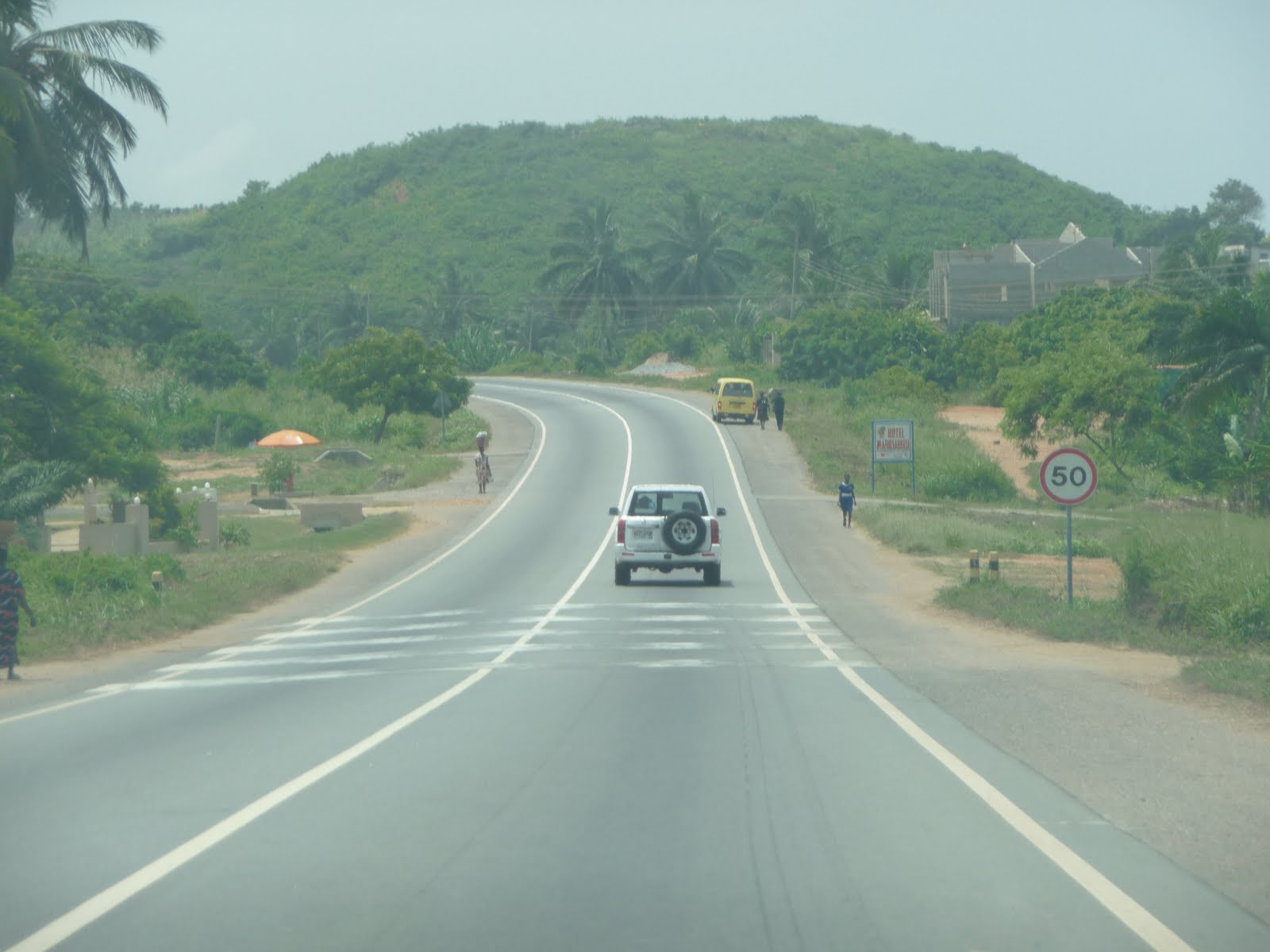
I need to describe, again, the road between Accra and Cape Coast.  I wrote about it in my May 17 blog.  I described the countless numbers of speed bumps.  Here is an example of one of them.

I will recommend, again, that the country’s motto should be Ghana, the Land of Speed Bumps, or at least it should be the informal name of the Accra to Cape coast highway.   This is also the road that I described as having the Overspeeding Kills signs.  Here is an example of the signs. 


Two incidents on this last trip made it obvious to me why there is a need for some serious vehicle speed control on this highway.   On our way out from Accra to Cape Coast we came across an example of the danger on this road.  We were about 15 km from Cape Coast coming up a slight hill when we noted about a dozen vehicles stopped along the right side of the road.  All of the passing traffic slowed down.  As we drove by the stopped cars we could see off of the shoulder of the road, about 20 meters down into a ravine, at the end of a swath of flattened elephant grass, an upside down vehicle.  It appeared to be either a small bus or a tro-tro.  We didn’t have time to note details and we didn’t feel it appropriate to stop but we could tell that this vehicle went off the edge of the road at a pretty high rate of speed, took out 20 meters of vegetation and flipped onto its top.  I’m sure there must have been fatalities.  No one (except us) uses seat belts in Ghana.  The tro-tros don’t even have them.  About an hour and a half later we witnessed a second example of the dangers on this road.   We were just outside of Takoradi.  As we rounded a bend in the road we came to a second area with a lot of stopped cars.  This time it was an accident with a jackknifed 18 wheeler, turned on its side, and by the appearance of the surrounding vegetation, it had slid  down the road on its side, the trailer pushing the truck, for 50 meters and then eventually off the edge of the road.   I’d like to think this was due to overspeeding but I would bet it more likely to be a consequence of failure of the electric brakes on the trailer.  I am appalled at the poor condition of the trucks and truck/trailers that drive the highways here in Ghana.  There must not be any required inspection service to check for things such as electric brakes.  About two weeks ago Marsha and I drove from the MTC in Tema back to Accra at 10 p.m.  We passed four trucks and truck/trailers on this 20 km of highway that didn’t have marker lights, or didn’t have marker lights or brake lights, or one that didn’t have marker lights and didn’t have headlights.   How does a truck like this not attract the attention of police?  It is an accident getting ready to happen.  I can’t imagine that any of these trucks without marker lights had electric brakes that worked properly.  It has now become very scary to us to see one of these big trucks coming towards us on the road knowing that it might not have adequate braking.  Maybe there needs to be some new road signs warning about the lethal potential of inadequate electric trailer brakes.   

On a lighter note I need to describe the beautiful geography seen along this highway.   It is very green (obviously the rainy season).  The hills are moderate sized and smoothly rolling for the most part with occasional visible rock outcroppings.   It looks much like the hills of central/south Missouri, except the vegetation is different.  The most common trees along the roadside appear to be a locust type tree, moderate in size (10 – 20 feet tall), and growing very close to each other.  These have obviously been planted after the road construction was completed.  Farther away from the road the trees are much bigger.  The tallest trees are the Kapok trees.  These are magnificent trees.  They dominate the landscape.  They grow as individual trees standing alone, looking like sentinels.  They can be seen from a long distance away.  They have large, straight trunks with horizontal branches that take off from the trunk about 30 – 40 feet up from the base.  The dense canopies are magnificent.  One looks at this tree and can imagine an entire community of animals living in the canopy.  The roots are large and visible at the base of the tree, taking off from the tree 10 – 15 feet from the bottom and extending in many directions, like supporting guy wires for a large tower.  I’ll put some pictures here so you can see what I’m describing.  The first picture is taken from about 100 yards away.  The second tree is in Aburi Gardens and Marsha and I are standing between the roots.  


Other trees, smaller in size, are interspersed among the Kapoks, but they are all dwarfed by the Kapoks.  Some of these smaller trees are fruit trees (papaya and mango.)  I do not recognize the others.  Elephant grass fills in all the areas between the trees.  The grass is everywhere.  It must be like a weed.  It is 6 to 10 feet tall and dense enough that one could not walk through it without having to cut it down.  It waves with the breezes like the gentle rolling of a green ocean in the afternoon.  The elephant grass grows right up to the edge of the road.  On this trip we noticed a lot of men with machetes cutting the elephant grass from the edge of the road  back about 10 feet.  Each of the men had a machete in one hand and a snake stick in the other.  Before cutting into the grass the men would poke into it several times, checking for snakes.  Yikes!  I hope they get hazard pay for this kind of work.  

One last story.  I’m sure you’ll think I’m making this up.  I really should have President and Sister Froerer tell it.  They shared it with us.  (Buck and Kathy Froerer are the couple in charge of the Tema Missionary Training Center.)  About two weeks ago one of the guards at the MTC killed an alligator in the parking lot.  Yes, you heard what I said.  An alligator.  An alligator in the parking lot right in front of the building entrance.  According to Salasi,  a female employee who has worked at the MTC since it opened in 2002, this is the eighth alligator that has been killed at the MTC.  They come from a small stream behind the MTC and somehow get into the guarded compound (through the storm drains?) looking for garbage.  Salasi said that if the front doors are not closed at night they will come into the building.  So much for worrying about cockroaches. 

This alligator was a small one, only about four feet in length.  The guard was quite pleased with the kill.  He was planning on taking it home for his family.  “Tastes like chicken.” (That’s what I’m told he said.)  Here’s a picture of the guard with the alligator.

You will probably look at the picture and say “looks like a lizard” just as I did.  But the guard said it was an alligator based upon the position of its feet.  It doesn’t look very big at all, but if I were President and Sister Froerer I would probably lie awake at night wondering where in the stream behind the MTC is this little one’s mother or father and whether he or she would come looking for the lost baby.  Are the front doors locked?  Gunnar told us that when he lived in Florida he was taught that you assume every body of water in Florida has an alligator in it.  When Karen Blixen lived in Africa (the book Out of Africa) she built a pond on her farm and years later had to kill an alligator in the pond.  The only body of water that the alligator could have come from was many miles away.  These critters are obviously quite resourceful. 

Marsha and I want to thank family and friends who have recently sent us packages, letters, and e-mails.  It has been like Christmas in July.  Thank you very much.