Monday, May 17, 2010

Week #17


I’m going to describe Cape Coast today, but before I start I want to share a few events from this past week. 

I planted my garden – two flower pots with tomatoes.  The seedlings came up in five days.  They are about two inches tall right now.   I will have to thin them this week.  I don’t know why I’ve waited until May to plant tomatoes.  I could have planted them in January.  Ghana is like a giant Edward’s Greenhouse:  the temperature fluctuates less than 10 degrees F from day to night, the daylight is 12 hours long, and the humidity is constant.  I’ll keep everyone up to date on the progress of the Ghana Tomato Project. 
Here’s a picture of my garden at one week.

Marsha and I went to get our Ghana drivers’ licenses on Thursday.  The process here puts to shame any inefficiency associated with Ada County Licensing.   Give thanks the next time you are in Ada County Licensing if you only have to spend an hour.  Marsha and I spent three hours getting our licenses.  And it would have been much worse if we hadn’t had Kofi Bolley with us.  Kofi is the church employee in charge of vehicles, and, therefore, I suppose by logic, the one in charge of those who drive the vehicles.  Kofi did most of the work for us.  Thank goodness for Kofi and the Ghc 200 we gave him.  We parked outside the licensing building and waited in the car (air conditioner running) while he went inside.  We waited about an hour.  Kofi returned to the car with forms that needed to be filled out.  He filled them out for us, had us sign then, and attached a passport photo to the application.  He then took our Idaho drivers’ licenses and disappeared for about forty five minutes.  He came back with a form indicating that we had passed our driving test.  Pretty impressive for not having left the car.  I suspect some of the Ghc 200 went towards our successful passing the test.  We then climbed three flights of stairs and went down a long, narrow hallway to a very cramped office where we signed some forms and wrote our cell phone numbers on the paperwork.  The office was so small that only one person at a time could step up to the desk and sign papers.  There were many standing outside waiting to go in.   Kofi left us again.  We waited in the narrow hall for a half an hour and then went to a second office where we placed our right index finger onto some kind of scanner, signed an electronic signature, and had our picture taken.  The clerk then produced a “temporary” paper license good for three months.    Apparently they can’t make the permanent plasticized licenses on site.  Kofi will go back in three months and pick up our “permanent” licenses.  Amazing process.  And Kofi even gave us back Ghc 10 .  What a deal.  A driver’s license with change back. But I don’t think I’ll ever complain about US government inefficiency again.   

 
This is a picture of some flowers that grow in abundance outside our apartment stairs.  We don’t know for sure what they are called.  They look like the Bird of Paradise flowers of Hawaii.  There are different bunches of these flowers around the apartment grounds, all a little different in color.  They are always in bloom.


We had a very sick missionary this week.  He had been experiencing renal colic for about a week and hadn’t called anyone.  He called me last Sunday night when he realized he had gone over 24 hours with pain and without any urine production.  We sent him to C&J Hospital, one of the smaller hospitals we have used in the past.  They didn’t have a urinary catheter (can you believe that) so they sent him on to Korle Bu, the teaching hospital.  Unfortunately, this is like sending Daniel to the lions’ den.  You really don’t know if Daniel is going to be alive in the morning.  The missionary made it to a ward by early morning.  He needed a catheter and IV fluids, both of which had to be purchased off site and brought to the ward.  He needed IV medications – pain meds and a diuretic, both of which had to be purchased from the pharmacy and brought to the ward.  He needed some blood tests, and, yes, you guessed it, he had to go to the lab and pay for them in advance.  And, by the way, he had to have his hospital stay paid for in advance. If you can’t pay you can’t come into the hospital.  He was seen by a urologist sometime in the early morning.  The urologist ordered a CT scan of his abdomen.  And you can guess what needed to be done.  The scan had to be paid for before it could be scheduled.  The contrast dye had to be purchased off site and brought to the radiology department with the patient.  And, because he was a white patient with white people helping him, the cost of the CT increased from the first quote of Ghc 240 to Ghc 340.  No pay, no scan.   I think you can you visualize this situation.  It frustrates me beyond description.  This place is a conglomeration of buildings spread out over an area of about a square mile.  Every time I’ve been there it has been packed with people, in the halls, lying on gurneys, lying outside on the benches, waiting in cars, standing in the streets.   It is equivalent to the large teaching hospitals of the US but without any of the sophistication of US medicine.  And it is all based upon a pay as you play model with bribery thrown in for good measure. 

The missionary had the CT scan 48 hours after admission.  It demonstrated a stone in his left ureter.  The urologist, who refused to call me or even come to the ward when I was there, indicated to the missionary that surgical treatment would be needed to remove the stone.  I did some quick long distance consulting with Dr. Bill Jones, a urologist from Boise.  I started making arrangements to get this missionary to Johannesburg, South Africa.  And then the missionary got better.  He passed the stone. We paid our charges and got him out of the hospital.  It was a tense 96 hours.

Before I get to Cape Coast let me describe another “first.”  We’ve seen some buzzards in the past, usually from a distance.  They are much less common than the vultures that frequently fly overhead.  But today, on the way up Independence Avenue Marsha and I saw two buzzards sitting together on a light post.  The light post angled over the road.  The birds were sitting out on the very end of the light post, watching the passing traffic, moving their heads with the passing traffic, just as you would expect buzzards to act.  They were smaller than I had anticipated.  But they had the buzzard pose that is often accentuated in cartoon drawings:  narrow shoulders, thin, curved, neck with a small head bent forward surveying all things below.  It was exciting to see them that close. 

  Let me describe Cape Coast.  The guidebooks say that Cape Coast is a tourist destination for Ghana.  The doctor that I replaced, Mark Stubbs, said that Cape Coast is “like Hawaii except for more goats and more garbage.”   I would tend to agree with Mark.  There are stretches of the beach with coconut palms lining the shore that look exactly like Hawaii.  The water is even appealing with moderate rolling waves, and narrow, sandy, beaches.  But on the other side of the coastal high way is poverty.  It is a tourist destination if you only look to one side of your view.  This next picture is what you see when you look to the side of the road opposite the coast.

 Cape Coast is actually two communities about 12 km apart:  Cape Coast and Elmina.  Both are sites of castles built in the early 17th century by Europeans: the British, and the Portuguese.  The Dutch built a castle in Accra during the same era.   On his visit to Ghana last summer President Obama visited the Cape Coast Castle, the oldest of the three castles.

Let me interject one thing, here, to show how much the Ghanaians love our president.  Just inside the castle wall, at the spot where the guided tours start, there is a marble plaque set into the stone wall.  The plaque says “At this spot, on _________ (I don’t remember the date, sometime in July 2009) President Barack Obama unveiled this plaque.”  That’s all it says.  I’m not making this up. The Ghanaians all take pictures of this plaque.  I didn’t take a picture of the Obama plaque.  I took a picture of a plaque about 10 feet away.  It has been there for many years.  It seemed more appropriate.  
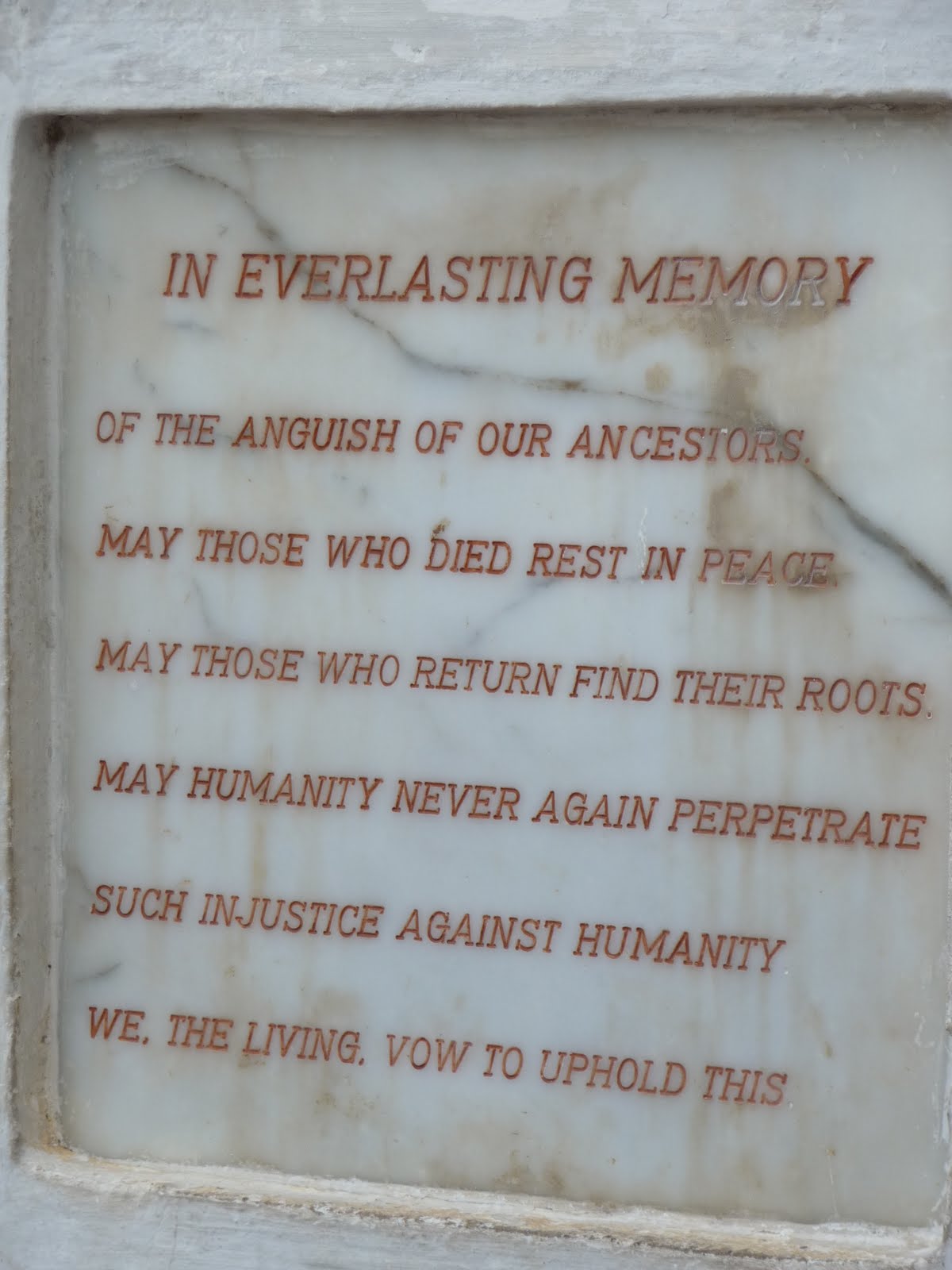


Back to the castles.  All of the castles were built originally as settlements/fortresses but they eventually evolved into prisons used for holding slaves in preparation to being shipped out to various parts of the world.  The history of the slave trading is more complicated than I had always imagined, having believed all my life that the Europeans captured the slaves, brought them to the castles in chains, and then took them to overseas destinations, such as the West Indies, where the slaves labored on plantations.  Contrary to this notion is the fact that most of the West African slaves were captured by their own countrymen, the dominant tribe, the Ashantes, who brought them roped together to the castles where they traded them to the European merchants for guns and alcohol.   Knowing this fact does not diminish, in any way, the pox on humanity for these two hundred years of cruelty, but it does allow me to view the Europeans with less disdain: they were simply businessmen, dealing in a buy/sell market, with the unfortunate commodity being humans.  One cannot walk these castles without feeling the morbid history behind the walls, in the corridors, in the dungeons, and at the large gate – the Door of No Return – where the slaves would pass through to be crowded onto the tenders and taken out to the slave ships.  I will put in a few pictures here to try and convey the feeling.  The first picture is the entrance to the male slave dungeon.   This is where the slaves would enter to be kept in captivity until departure.  The second picture is the door they would exit. 


 Marsha says I get a little carried away in my writing.  She’s probably right.  Let me describe the other “tourist attraction” in Cape Coast:  the Kakum National Park and its canopy walk.  I’ll do this without getting “carried away.”  The park is about an hour north of Cape Coast.  It is a true rain forest with a rope bridge canopy walk 350 meters long, suspended 40 meters above the canopy of the forest.  The morning we did the walk the sun was shining and the vistas seen from the canopy walk overlooking the forest were stunning.  The next two days it rained.  It is a rain forest, after all.  I’ll put in a few pictures here.  


This is a picture of the Coconut Grove Resort.  We did not stay here but we had dinner at the beach side restaurant.   

 
Let me conclude with some comments on our driving to Cape Coast and back.  Cape Coast is about 120 km from Accra.  It took an equal amount of time to get out of Accra as it did to drive to Cape Coast.  The traffic is miserable on the west side of Accra.  (We drove out on Friday mid day, which probably didn’t help the traffic mess any.)  The road is actually pretty nice.  There’s not a lot of potholes.  But there is an inordinate number of speed bumps.   Each community has speed bumps 20 meters apart all of the distance that the road passes through the community.  And there’s a community (village or small town) every 10 – 15 km.    These speed bumps are not a single speed bump.  There are usually 4 – 8 speed bumps each 5 meters from the next.  It makes for a lot of slow down/speed up driving.   The speed bumps are to obviously slow down the traffic.   There is a second deterrent to speeding.  Every 10  km or so there is a bright red roadside sign that says OVERSPEEDING KILLS, (not "speeding kills", but "overspeeding kills") with a smaller sign underneath detailing the deaths:  “At this site 6 people died,” or “At this site 32 people died” (I’m not making this up) and then the best one “At this site over 3 people died.”  How many over three?  Maybe three and a half?   Occasionally there are other red signs proclaiming OVERTAKING KILLS.  If the speed bumps don’t make you want to slow down I’m sure that the road signs do.  Who would want to be memorialized on a road sign?  

I’ve decided that Ghana needs a catchy tourist phrase, like Illinois, the Land of Lincoln, or the United States of America, the Land of the Free, the Home of the Brave.  Maybe they need a catchy motto, like New Hampshire, Live Free or Die. Or maybe something along the lines of Remember Only You Can Prevent Forest Fires.   Here’s some suggestions:  Ghana, the Land of Speed Bumps, or Ghana, the Land of Scary Road Signs.  Or Remember Only You Can Prevent Overspeeding.  

Have a good week.


Saturday, May 8, 2010

Saturday, 8 May 2010


Marsha says that if I don’t get a blog written this weekend I’ll start getting hate mail. I don’t want that.

I appreciate the comments and feed back from the blogs that I have written so far. The effort to write a blog is worth it if just one person gains an appreciation for this country and what we are doing here.

It seems the first few weeks that we were here I couldn’t wait to sit down and describe our new surroundings. Each day was exciting, a new adventure. Now, I have to think for a while of events/items that would be appropriate to describe in a blog. Most of the “newness” of Ghana has worn off.

I had an experience about two weeks ago that was a little disturbing. I was driving my 5 km route to home, up Independence Avenue, and taking some videos with my GoVideo camera. I had the camera in my right hand on the top of the steering wheel. I was trying to capture the variety of street vendors working alongside the passing cars, on the edge of the road and in between the two lanes of traffic. If you haven’t seen a GoVideo camera it is about the size of a cell phone. I had it between my thumb and finger in my right hand, with the hand on the steering wheel at about the 2 o’clock position, pointing the camera forward, trying to capture on video what I could see as I drove the road. I had taken about four 20 second segments while moving slowly with the traffic. And then I came to a stop at an intersection. I kept the video camera going trying to capture the oncoming passing of the vendors. I had been stopped for only 8 – 10 seconds when I heard some yelling to the right of me. I looked to the right and the driver of the adjacent car had rolled down his window and was shouting at me (local language, I didn’t understand any of it but I got his message) and shaking his finger at the camera. I turned the camera off and put it in my lap. He continued shouting, not to me, but to all the vendors around us. They all stopped, probably 10 of them, and started coming toward me. All of them were shouting at me (still didn’t understand a word they were saying, but the body language didn’t require translation.) One of the vendors, a young woman selling dried plantains, stood at my driver’s window for several seconds, and hit the window with her hand. For the first time since arriving in Ghana I felt threatened. I patiently endured the insults and waited for the light to change.

So, what did I learn from this experience? First, I don’t think I’ll take GoVideo images while sitting at that intersection again. Second, I think I have a better appreciation for the dignity of these people. I obviously was doing something that was demeaning to them. I doubt they thought that taking their picture would “steal their souls.” (Quaint thought.) But I do suspect that my taking their picture was like unto taking the picture of an animal on display. It was offensive to them. I am sure I would have felt the same if our positions had been reversed. I wonder what would have happened, though, if I had rolled down my window and offered to buy something from each of them. Maybe the anger would have changed. Maybe not. I don’t think I’ll try to find out.

Another incident. This one is hilarious. It relates to the comment in my last blog that Ghanaians aren’t as conscious of skin color as we are. I think they are conscious of skin color, but not in the purely racial sense that we think of it. To them, white in contrast to their black skin does not imply a sense of tension that we unconsciously feel, in the US, when we think of blacks in contrast to our whiteness. As whites we are always careful of using skin color as a description of a person. The Ghanaians aren’t concerned about calling someone white. There is no implied racial tension. They would feel and act the same if we had purple skin. Maybe this doesn’t make sense, so I’ll describe the incident to explain the point I’m trying to make.

A week ago Thursday I drove to the Medical/Dental Council building to turn in my licensing application. (By the way, they didn’t accept the application; it turns out I’ve got to either “sit for examinations” or get an exception to the examination rule. They hadn’t told me about the “examinations” requirement when I picked up the license.) There is no parking at the Medical/Dental Council building. I parked behind the adjacent CocoBoard building. I had to walk through the lobby of the CocoBoard building. To get out the front door I had to walk through a turnstile, that, because I was exiting the building, had to be electronically released to allow pedestrians out. The incoming pedestrians could walk through the one-way turnstile. I stood for a moment waiting for the incoming pedestrians to come through the turnstile. When there was a break I looked at the man who controlled the electronic button. He acknowledged me and pushed the turnstile button. As I started towards the turnstile a Ghanaian behind me cut in front and went through the turnstile. I paused and looked at the man controlling the button. He acknowledged me again and pushed the button. I started toward the turnstile and for a second time a Ghanaian behind me cut in front to go through. The same thing happened a third time. At this point the man controlling the button was getting irritated. He looked at me, pushed the button, and said, in a LOUD VOICE, with a finger pointed at me, “White one! Go!” No one cut in front of me. I walked through the turnstile, privileged to have exclusive access. (If I had thought quickly enough I should have asked “Who, me?”) Had my skin been purple, the man with the button would have invited the “purple one” to go. Imagine a similar scene in the US. Do you think that the button man would have yelled “Hey, black one. Go.” Does this make sense?


Enough philosophizing. Let me describe a fence being built across the front of the empty lot to the east of our apartment. I put a picture of this field on the blog dated 7 February. You might want to look at the picture again to see the cattle crossing the empty lot.

As I mentioned on that blog Marsha and I watched the cattle come through the field every three to four days in February and March. We’ve not seen them the past two months. We’ve noticed as we’ve walked the neighborhood that signs on this property have been put up indicating that the property belongs to the government and that there is to be no trespassing. Maybe that’s the reason for the disappearance of the cattle. It hasn’t cut down, however, on the pedestrian traffic. So I guess that the government has decided to put up a fence. A concrete fence. (I’m really tempted to make a comparison, here, to US immigration fences but I’ll resist. I'll seize the opportunity, however, to make a comment about the Ghanaian government’s simple solution of building a fence compared to how the Obama administration would have handled the problem. If faced with this problem I can visualize President Obama holding a press conference to announce the creation of a new bureaucracy called the Wandering Cattle Department, with a billion dollar budget to teach cattle to read warning signs, a whole cadre of Keep Out enforcers, and an equal number of legal staff to represent the rights of the cattle when arrested by the enforcers. We’d have to build prisons for the delinquent cattle and employ a lot of cattle guards. And that doesn’t even address the Wandering People problem. That would require a second bureaucracy. Oh well, just a thought. I’d better get back to the fence.)


Three weeks ago I noticed a lot of men working along the street that fronts the empty lot. They were digging, by hand, a trench about five feet deep. I didn’t measure it but the trench was up to the heads of the workers. I could see their heads and watch the dirt being thrown from the trench. They dug the trench, about 40 yards long, in several days. They then started building pillars, first forming reinforcing bar into skeletons, and then building wooden forms around the skeletons. They then poured concrete into the forms. Once the pillars were done they started the solid block wall (not cinder block which is lighter but blocks that look like they are at least 60 – 70 pounds based upon how difficult it appears for the men to carry them.)

The men have done all of this without a backhoe or any other piece of mechanical equipment, without a transit, without electricity, and without concrete being delivered to the site. They cut the reinforcing bar by hand, as well as the wood for the concrete forms. They mix the concrete on site. Each morning water is carried in buckets by hand from a little stream quite a distance away to a location on the empty lot where piles of sand and gravel have been previously deposited. The concrete is mixed at this site. The concrete is moved in wheel barrows to the pillars and then lifted up to the top of the forms in what appears to be about a two gallon bucket. A worker sits on top of the forms and pours the concrete in the forms and tamps the concrete down.


This is a picture of the worker sitting on one of the pillars. The men who are building the block walls are doing it without any electrical equipment. They score and break the solid blocks instead of cutting them. The assistants bring the blocks, one at a time, balanced on their heads. I have not seen one of the workers wearing gloves. And by the end of the afternoon they are all shirtless, their skin glistening with sweat.

I would love to be able to photograph or video this process but I’m a little gun shy about using the camera without permission. I took these photos from our front porch balcony with Marsha’s little camera which has a 10 x zoom.

It is now midday on Saturday. The power to the apartment went out about an hour ago. We are on the generator at the moment.

I’m going to put two photos from Cape Coast in here. We were there last weekend for a Mission President’s Training Seminar. I’ll write more about it this week and post it next weekend.


Thursday, April 22, 2010

Week #13 – three month progress report


I wrote most of this on Sunday which was the first day since our arrival in Ghana that the sky was completely clear.  There was not a cloud visible all of the day!   It was exhilarating.   BLUE SKIES.  And the night was clear.  We could see Orion near the west horizon.  Today is Thursday.  The daytime overcast returned on Monday. 

We have been here three months as of this past weekend.  This week’s blog is going to be a three month progress report.

I went back and looked at my first week’s blog.  Quoting from that entry:  “We are confident that we will be able to find meaning and fulfillment in our daily lives once we can get beyond the sights/sounds/smells of our surrounding and the inconveniences of living here – having to wash every fruit and vegetable (and eggs) and all the dishes in Clorox, having internet which works sporadically, having to drive with white knuckles, and getting used to the heat – the oppressive, moist heat of the day, and night (it changes very little at night.)”


I would give us a solid B or maybe a B+ grade for getting “beyond the sights/sounds/smells of our surroundings.”   We don’t notice the dirt, the garbage, the torn up roads, and the incomplete construction as much as we did in the beginning.  If we notice anything, now, it seems that we see the people much more than the surroundings.  We often find ourselves commenting to each other about the beauty and elegance of someone that we see.  Just this morning on my drive down Independence Avenue I noticed one of the street vendors selling water bottles.  I watched her for the few moments the cars were slowing at an intersection.  She was probably in her early twenties.  She was tall and slender wearing a halter top and a ¾ length cotton skirt and sandels.  Her top was blue but her skirt was bright yellow which stood out against her black skin.   Her hair was cropped and she carried a large aluminum saucer with one liter water bottles balanced on her head.  As she approached our line of cars she smiled to each car and offered water.  Her teeth were ivory white and perfectly straight.  Her forehead was smooth, her eyebrows thin, barely visible, her nose was narrow, her lips were small.  She had no visible makeup but didn’t need anything to enhance her natural beauty.  She walked briskly, very erect, carrying the load on her head as easily as someone would wear a hat.  As she passed my car I noticed that the skin of her neck, shoulders and arms glistened in the sun due to her sweating.  It was a moist reflection, very much like the condensation that occurs on a cold water bottle placed in heat.  Yet her clothing did not appear moist.  She could have easily been a model or on the cover of a fashion magazine. 

We have noticed that most Ghanaians dress very well, despite their overall poverty, with modest, clean, clothing.  We do not see immodest dress on the women; they do not allow any midriff skin to show.  The Brittany Spears fashion line is not popular here in Ghana.  The men dress equally well, with a surprisingly large percentage who wear long sleeve shirts with French cuffs.  I have only seen one person with a tattoo (very difficult to distinguish because of the dark skin), and it was on the ankle of a young woman.  I’m not sure that she was native to Ghana.   All of the children and young men/women have short hair.  Some of the older women have beautiful hair styles, most of which are braided hair extensions put up on top of or behind their heads.  (I’ve asked the women about the hair extensions.  They have them rebraided about every three to fours weeks.  It takes 3 – 4 hours to do a complete head.)   Some of the women wear wigs.  The men are clean shaven with close cropped hair cuts.  I have seen only a few “Afro” hair styles and I suspect they are non Africans.  No one smokes, here.  Isn’t that amazing.  None of the Ghanaians, at least.  The only smokers are non Africans.
 
I would give ourselves an A in getting used to the inconveniences of living here.  It seems natural, now, to wash all the fruit/vegetables and eggs in Clorox.  Ditto for the dishes.  Out internet is not a problem.  We have a satellite modem that is always connected.  It is not fast, but at least it keeps the internet available at all times.  I don’t drive with white knuckles any more.  I do drive more defensively than at home, not taking my eyes off the road and surrounding vehicles.  But I’m not exhausted after driving to work or home.  And the heat, well, it remains hot but I (we) don’t seem to notice it as much.  We still sweat large quantities when in the heat but are not as panicky looking for airconditioning as we were three months ago.  

I would like to comment on two items that I’ve been thinking about a lot.  The first relates to malaria.  Having never been in a malaria endemic area Marsha and I arrived with a mental image of needing to take exorbitant precautions daily against the disease: DEET all over our bodies, mosquito repellent clothing, not going out at night, etc. and worrying incessantly about the enemy – the anopheles mosquito.  We both laugh, now, as we recall our first night here.  We were staying in temporary housing and had prepared for bed.  As we were turning the lights off we noticed a small flying insect in the room (the anopheles mosquito is very small, almost not visible, quite unlike the large mosquitoes of the American West).  We tried to kill it but could only catch fleeting views of it.  We were not able to eliminate it.  So, we prepared for bed both of us convinced that it was a malaria bearing mosquito and we were its next victims.  We covered ourselves with DEET and slept very restlessly, awakening to check to see if we had been bitten.   Now, three months later, we don’t worry very much about malaria.  We use DEET occasionally, but for the most part don’t take the onerous precautions we did in the beginning.  We are not as fearful of malaria.  We have become Malaria Russian Roulette players.  We carry our malaria medication, Artrin, with us all the time.

Having dealt with malaria on a daily basis for three months I want to offer a medical observation.  The incubation for malaria is about 10 – 14 days.   When malaria becomes clinically apparent it does so with the onset of a sensation of being “ice cold” – the cold phase --  characterized by shaking chills usually accompanied by headache/bodyache, fever, and gastrointestinal disturbance.  This lasts up to six hours then passes into the hot phase when the infected patient describes a “burning up” sensation accompanied by profuse sweating.  If the current medication for malaria (the Artrin, a combination of artesunate and lumefantrin) is given during the cold phase the patient is usually better within four hours of taking medication.  If started later than four hours after the onset it takes longer to work.  I am amazed that this combination medication is so effective for such a dramatic disease.   In reality, the medication makes it easier, and more successful, to treat acute malaria than a viral URI.   

My second comment relates to the changes I’ve experienced in my concerns about being white in a black society.  It is hard to describe the evolution of this change in attitude, but I have become much less aware of my whiteness in the past three months.  I remember being in ShopRite the first weekend here and noticing three white women near the fruit section.  By reflex I started to push my cart toward them, I guess wanting an unconscious sensation of being among my own.  I don’t do it anymore.   In fact, I hardly pay attention to the presence of white people at all.  I obviously don’t feel as self conscious of being white as I did on arrival. 


Along this same line I have also come to appreciate that the Ghanaians have very little awareness of skin color.    Let me tell you why I can say this.  (This happened to me about a month ago and I’ve thought about it quite a lot since then.)  Marsha was looking at fabric at a vendor’s shack and I was standing in the background watching her look at the different patterns.  The owner and I started chatting about trivial items and he offered to show me some men’s shirts made of Ghanaian fabric.  He brought me a number of them and held them up to me and commented each time how good I would look in the shirt.  He then said that if I were wearing a Ghanaian shirt I would “look Ghanaian.”  I looked at him and laughed and said, incredulously, “there is no way I would look Ghanaian wearing this shirt.”   He kept insisting I would.  I thought he was just trying to make a sale.  But I don’t think so.  I started thinking there, and have rethought about it a lot since then, that this man was serious in his assertion that if I would wear a Ghanaian shirt I would  “look Ghanaian.”  He didn’t see my whiteness as the determining factor in whether I looked like the locals or not.  Think about that for a moment.

By the way, I bought the shirt.  And I’ve worn it several times.  A couple of the native Africans have commented that I have looked very “Ghanaian.”  It amazes me!  To think that a shirt of African fabric is all that’s required to make me look like a native of Ghana.


I can’t think of anything funny this past week.  I guess I’ll close with a shopping experience.  This is to serve as an example of the Greatness to whom I am married. 

Marsha and I were at the Accra Mall on Thursday of last week grocery shopping.  I knew that I had only a little money with me.  As we were going through the store, adding more to the grocery cart, I kept asking Marsha if we were going to have enough money for checkout.  She would look at me and calmly say “yes.”  As we added more and more to the cart I kept asking about our amount of cash on hand.  She seemed confident we were not beyond our means.  I need to interject here that I dread the day when I have a check out confrontation – the checkers are not friendly at all and customer service here in Ghana is not a principle taught, let alone understood.  I fear having to disagree with an unfriendly checker.  And I fear worse having to explain why I don’t have enough cash, and begging her to take a credit card, which, by the way, is not safe to use here.   As we approached the check out stand with a full cart and an unknown amount of cash in our wallets I envisioned us having to ask the checker if she could take back some of our items for credit to get us within the amount of our cash on hand.  As we started through the check out Marsha calmly asked me how much money I had.  I told her Ghc 16  (sixteen cedes).  She was watching the running total and doing some mental calculations.  She asked for my Ghc 16.  As the grand total came up she handed all of our cash to the checker.  We received  Ghp 68 (68 pesowas,  about 50cents) as change.  As we loaded the items into our cart she looked at me with the look of “you are such a skeptic, did you really doubt me?”    I bow to her shopping Greatness!

Talk to you next week.   (This is papaya cut cross wise instead of length wise.) 


Monday, April 12, 2010

11 April 2010 weeks # 11 and 12


I thought I’d start with this photo.  It made me think of sailing. 

Last weekend I was traveling to and from the states and was unable to post a blog.  I had the unfortunate responsibility of having to accompany two missionaries home.  Both had developed mental health problems that prevented them from continuing their service here in Africa.  One had to be sedated to travel safely.  We left on Thursday night and flew through the night to Frankfurt, Germany.  We had an eight hour layover in Frankfurt and then flew to Denver where I delivered the sedated missionary to his family.  I then traveled with the second missionary to Salt Lake City where his family met us.  It was a difficult experience for all three of us, especially the two missionaries.  Both were tearful and very upset about returning home.   I sat between them on both flights and had a lot of time to talk to them.  There was nothing I could say, and I did try, to convince them that they had no control over the development of their mental health issues.  They were not failures.  I am hoping with appropriate medication and counseling they can get on with their lives. 

I made it to the hotel late Friday night.  I spent Saturday catching up on sleep and shopping for items that we need and can’t get in Accra.  I spent Sunday with Christopher and left Monday morning to return to Africa.  The Salt Lake to New York City (JFK) flight was OK, but the JFK to Accra flight had an incident that deserves an entry on my “Funnier Now Than When It Happened” list.  It was about one hour into the ten hour flight.  I was seated in the back, left side section, in the aisle seat.  Next to me in the window seat was a large man, not fat, just very big and muscular.  A shoe horn could have helped him squeeze into his seat.  He was so big that he couldn’t put down his serving tray because it rested on his legs.  (He really should have been in business or first class.  On second thought, I should have been in business or first class.)   In front of me (aisle seat) was a woman in traditional Ghanaian dress, with the matching fabric dress and headwrap.  The head wrap was very colorful and VERY TALL.   Behind me (aisle seat) was another big man.  I didn’t look at him while boarding, and after this incident really didn’t want to look at him the remainder of the flight.  The two aisle televisions that I could see were right above me and eight rows ahead. 

The following all happened in the space of about ten minutes.  The flight attendants were serving drinks at the same time the in flight movie started.  They served me and the man next to me.   Out of the corner of my eye I saw this man take his Coke and balance it on his serving tray, the serving tray that was resting on his legs.  The flight attendants moved on to the row behind.  This man tried to reach for something beside his tray and he spilled his Coke over the side of his tray onto the left leg of my suit pants and into my shoe.   I don’t think he got any of it on himself.  He mumbled an apology but offered no help other than picking up his overturned plastic cup.  I got the attention of the flight attendants and had them hand me paper towels which I used to clean up some of the spilled Coke.  The towels did little for the wet pant leg and sock.  I patted them as dry as I could.  I took a deep breath and tried to remember what I had learned about forgiving others.  I also tried to mentally calculate how long it would take my sock to dry out and how difficult it would be to get a wool suit dry cleaned in Africa.

I decided to see if the in flight movie would be appropriate for watching.  I started to lean back to watch the screen over my head.   I got my seat part way back and the man seated behind me immediately pushed my seat forward.  I guess he figured I was infringing on his space.  I waited a minute and tried it again.  He pushed me forward a second time.  I tried it a third time with the same result.  I thought, again, about what I’ve learned about forgiveness.

Being resilient as I am (laugh, laugh) I decided to watch the screen eight rows ahead of me.  As I started to view the screen and to adjust the headphones to the proper audio channel the woman in front of me put her seat forward and sat upright, obviously interested in watching the same screen.  Her VERY TALL fabric head wrap came upright and blocked my view completely.  No matter how far I moved to the right toward the aisle I could not get a view of the entire screen due to this beautiful Ghanaian fabric head wrap in my line of sight.  I was not about to move left toward my Coke spilling neighbor.   

Fortunately, the movie was not worth watching.  I decided that there would not be any benefit gained from further pondering forgivenss so I decided on the next option:  drugs.  I searched for an ambien but discovered that I had packed them in my checked through luggage.  Aargh!  It was a very long flight to Accra.

I am going to insert some pictures taken two days ago at the Orthopedic Training Center in Nsawam (a two hour drive from Accra.) 


Marsha and I took Rebecca Tetteh, her mother, and her brother to the OTC.  Ike Ferguson was there with a team from SLC fitting wheel chairs.  Two physical therapists were part of the team.  I wrote about Rebecca in my week #5 blog.  She has just turned eleven years old.  She was born with congenital bilateral hip dsyplasia and bilateral club feet.  Through the assistance of a number of people she has had her feet repaired and now walks with crutches.  We brought her to the OTC to see the physical therapists.   We also wanted to have her orthopedic shoes and crutches examined – a 10,000 mile check up on the hardware.  She spent an hour with two therapists who instructed Rebecca and her mother, Roseline, on exercises at home to strengthen hip/pelvic musculature and to prevent hip contractures.  We then took her to the fabrication building and had her shoes and crutches examined.  The technicians took the crutches and repaired parts that were wearing.  They took her shoes and completely resoled and reheeled them.  The shoes have special platform positioning to prevent the body’s tendency to scar back into a club foot position.  The crutch repair and shoe renewal took about three hours.   The charge was Ghc 10.00, about $7.00.  


The Orthopedic Training Center is Ghana’s resource for individuals with extremity disabilities such as amputations, paralysis, polio, congenital disorders, etc.  It is a service provided by Catholic Charities.  Sister Elizabeth Newman is the director.  She has been at the OTC for about 35 years.  The OTC has an outpatient service, a mobile unit, and an inpatient service.  They have over 6,000 patient encounters a year.  The inpatient service has about 100 – 125 patients at all times. (The picture above is Sister Elizabeth talking to the mother of one of the inpatients.)  Most of these are children with congenital deformities, primarily club feet, and patients with new amputations.  We saw one girl about 10 years old with bilateral below the knee amputations, a left mid forearm amputation, and a severely deformed right hand (fingers absent,) all the consequences of injuries secondary to a fire earlier in childhood.  She was an inpatient at the clinic while the technicians refit her three prostheses, having outgrown her previous ones.  She was animated and excited to see us.  I did not glimpse in her eyes any of the despair I would have expected in someone with such devastating deformities.

As we were walking with Rebecca toward the fabrication shop a young man about 12 years of age with a right leg amputation, ambulating with hand crutches, approached us.  He and Rebecca had a brief encounter, pausing for a moment and glancing at each other, and then passed.   The encounter was very touching for us adults as we observed in these two individual’s eyes and body language a recognition for each that there is another person in this world with similar disabilities and that life does not need to be limited because of physical handicaps.  It was a precious moment.

Marsha and I have been in Ghana three months this week.  Each day is a new adventure.  Each person is a new story.  Each experience is endearing.