Monday, March 29, 2010

28 March 2010 weeks # 9 & 10


I was busy last weekend and did not have time to get a blog posted.  Apologies to anyone who noticed.

We have had a number of visitors these past two weeks.  Let me describe them.  They each have unique stories.

Lee Clegg is from Phoenix and is in Accra on business.  Three weeks ago, through a mutual friend he offered to bring us items from the states.  Marsha requested glad wrap, Costco canned chicken, black beans, and chocolate chips.  After his arrival he brought them by the office, unannounced, and left them on our desk.  (He comes to Ghana frequently and does this with each trip: brings a suitcase of items for people he knows living in Ghana.  It’s just like Christmas:  make a list and wait for Santa to come.)   We caught up with him his first week here and brought him over to the apartment for dinner.  He is fascinating.  He is involved in a business that is setting up the Ghanaian government website.  It is a lot of work requiring personal visits to the country.  We thanked him repeatedly for the generosity of his gifts and offered to pay him.  He refused.  He indicated that it is his contribution to the good work being done in Ghana.  We told him we’ll feed him each time he comes. 

Our next visitor was W. Cole Durham.  Cole is the Susa Young Gates University Professor of Law at the J. Reuben Clark Law School.  He was here in Accra for a law symposium at the University of Ghana Law School.  Cole was an undergraduate at Harvard with me.   
 We spent an evening together reminiscing about “the good old days” and sharing some of Marsha’s warm chocolate chip cookies (thanks to Lee Clegg’s bag of chocolate chips.)  Cole travels the world teaching and consulting on legal cases.  He described an upcoming appearance before the Supreme Court of Indonesia where he will be involved in a human rights case .  He had a deadline to get his opinion to Indonesia so it could be translated into the language of the country/court prior to his trip to the country. 

The third visitors were John and Cozette Welling.  John is a fourth year medical student at Ohio State.  He  and Cozette have been married nine months.  They were here as part of a fourth year medical outreach elective.  John and Cozette spent two months in Accra, Kumasi, and Tamale, the three biggest cities of Ghana, working with opthalmologists doing eye screening and surgery.  Cozette spent some of her time volunteering at orphanages.  They lived in a variety of housing ranging from nice to marginal, including one night in a tree house without any electricity.  (Being newlyweds they probably didn’t notice the condition of the housing.)  Talk about adventurous!  They lived with and ate all of their meals with the locals.  They visited every point of interest from Accra to the northern reaches of Ghana.  We first met them two months ago with their arrival in Ghana and then they called last week, back in town, waiting for their departure.  We helped them with some laundry and some transportation and then spent a delightful evening with them with dinner and looking at the slides and videos of their two month’s travel.  We took them to the airport for a late night departure to Amsterdam.

So much for our social schedule.  A week ago yesterday I went to Korle Bu (the teaching hospital) to meet for the third time with Dr. Kitcher, the head of the ENT department.  He invited me to go to the “operating theatre” with him.  You’ve heard me describe Korle Bu as WWI buildings not upgraded since being built.  It was a pleasant surprise to see the operating rooms which have obviously been remodeled in recent years.   The room designated for ENT surgery is generously large with most of the equipment fairly up to date.  There is no piped in gas or suction so the anesthesia machine is connected to tanks and the suction machines are portable.  There is a ceiling mounted Zeiss operating microscope with a teaching head.  The ENT service (staff and two residents) were doing a staging endoscopy for a patient with a base of tongue cancer.  I had an enjoyable time meeting the ENT and anesthesia staff, the ENT residents, the operating room personnel, and a number of nursing students.  There were about 12 people in the room, making it crowded but easy to meet all of them.  Everyone was very cordial.  Dr. Kitcher and I talked further about my teaching otology in the training program.  My application for Ghana registration/licensing is almost complete.   My former practice in Boise has generously donated equipment to be used in ear surgery and Laurie Southers, the manager of the surgery center, is assisting in its acquisition.  I have contacted the US Embassy to enquire of ways the embassy could assist in assuring the equipment’s safe delivery to Accra.  My goal is to have all this in place and functioning by summer.  I should be able to spend one half day per week at Korle Bu.

So much for technical talk.  Each day Marsha and I discover something new and interesting about Ghana and her people.  Sometimes it is humorous, sometimes it is sad.  This is a humorous discovery. 

Ghanaians have a variety of names.  Some are very American sounding like Daniel, Sharon, and Reuben.  Some are more native like Awo, Faustina, and Mensah.  (By the way these are all individuals we work with each day.)   They also all have a name, a “soul name,”  indicative of the day of the week upon which they were born.  Some use this name and some do not.  But if you ask them, they all can give you their day of the week name.


I was asking one of the office staff about this tradition and she was explaining the different names of the week for men and women.  I told her I was born on a Friday and asked her what my name would be.  I must interject, here, without revealing her name, that this woman is a big, strong woman.  (Remember, the women here in Ghana routinely carry a baby on their back and a load on their head.)   She looked at me for a moment, sizing me up and down, and said, “you would be Fifi.”    Fifi???    What kind of name is Fifi?  All of the male names she had mentioned were very masculine, like Kwame, Kweku, and Kwesi.  I wanted a name like one of those, something masculine, like Dragon Slayer, not Fifi.  I asked her to repeat, thinking I might have heard it wrong, but she smiled and said “Fifi.”   I was heartbroken.  So much for discovering my Ghanaian name.  I told Marsha about the experience, expressing my disappointment, but didn’t get much sympathy from her.  
 
Now the funny part.  About a week later Marsha and I were with Dr. Kwesi Dugbatey, a retired physician.  (Note his first name, it sure isn’t Fifi.  I need to write a blog about him sometime; he has an incredibly fascinating life story that should be in a book or movie.)  I mentioned to Dr. Dugbatey my disappointment in learning my Ghanaian birth name, “Fifi.”  He looked puzzled, thought for a moment, and then started laughing.  It turns out that my Friday birth name is actually Kofi, but when you are a small Kofi you are affectionately referred to as Fifi.  I ought to go back to the office staff who declared that my name was Fifi, and straighten her out, but I suspect she would demonstrate, with some kind of bodily harm, why she considers me a diminutive Kofi.   

Here is a parting picture taken on the way home to our apartment.  There are two sets of twelve barrels secured to the top of this trotro.  I can envision the disaster this would be with a low overpass. 


Monday, March 15, 2010

7 - 14 March 2010 Week #8

It was a pretty quiet week.  Nothing like the spike boys last week.  Marsha and I have been walking in the morning and marveling at the flora that surrounds us.  The bougainvillea is so abundant that it becomes overlooked when something new blossoms.  Yet you really can’t ignore the bougainvillea.  It is everywhere.  Here is a picture of a wall covered with three different colors of bougainvillea. 

A tree has blossomed this week for the first time since our arrival.    We have asked the locals its name and haven’t received a consistent answer.  The expats call it a “flame tree.”  The trees are very large with long horizontal branches.
The leaves are small like a honey locust and a medium green color.  The blossoms are very delicate, like a honey suckle, and red to orange red in color.  The blossoms are clustered around a single blossom that has longitudinal streaks of white on the petal, about 10 – 12 red ones for one streaked one.  The clusters of blossoms turn the medium green tree into a bright red tree.  Hence the name “flame tree.”  We see it everywhere now.   It especially stands out when viewed from a distance.


 We found a blossoming plumeria tree this week.  We noted it on Tuesday and returned to see it this morning.  It’s a single tree on the edge of a parking lot in front of what looks like a business building.  It stands there all by itself.  Just like a hitchhiker trying to get a passerby’s attention.  Well, we gave it our attention, both times this week.  The people standing in front of the building have probably wondered why the white ones were pulling the branches down and smelling the blossoms.  One sniff and it’s an instant time/space warp to Hawaii.  We brought blossoms home and put them in glasses in water, just like we do when we come across a plumeria in Hawaii. 


Some other observations about our environment:  the air is much cleaner than when we arrived, the sky is bluer, and the temperatures are hotter.  We’ve been told that March is usually the hottest month of the year.  We hope that’s true.  When we step outside each morning it’s like stepping into a sauna.  Those who know say that the rains will cool things down.  No one here talks a lot about the weather.  I guess there’s not much to say about it.  

Last Thursday we had Rebecca Tetteh in to Accra for x-ray pictures of her hips.  After we finished at the hospital Marsha and I drove her, her mother, Roselin, and her brother Michael home to Sotad, a village about 6 km from Dodowa.  It was about a two hour drive, not because of distance but because of road construction and crowded traffic.  When we finally got into the “rural” area of the drive we marveled at the beauty of the land.  It is so green and so full of vegetation.  It could easily be a country club setting if the local economy could support it.  

There is not a road sign pointing to Sotad.   You turn right just past Dodowa.  The road is part asphalt and part dirt with a few large waterholes to test one’s driving skills.  You then turn off this road onto a narrow dirt road.  Sotad is down this road.  The only building that we could see that would be considered a community building is the school.  We had to drive right through the front yard of the school.  A class of older students was sitting with its teacher under the tree in front.  The younger students were in back with another teacher, probably doing PE.  As the younger students saw us they broke from their teacher and came running. They surrounded the car and wanted our attention.  They pressed against the car, heads in our windows.  What a beautiful sight!  We would have liked to stop and get out but I think we would have never been able to get back into the car had we done so.  We would have been taken captive by 40 children!


We left Rebecca, Michael and Roselin at their home, drove back around the school and then back to Accra. The return trip was a little over an hour.   I am sure it will not be our last time to Sotad. 


    This is a picture of a roadside stand selling avocados.  We bought six huge ones for the equivalent of $4.00.  What a bargain, and Marsha says they’re the most delicious she has ever had.


Wednesday, March 10, 2010

1 - 7 March Week #7

[It is now Wednesday morning.  I was part way through uploading this blog last night and the internet went out.  Aargh!]
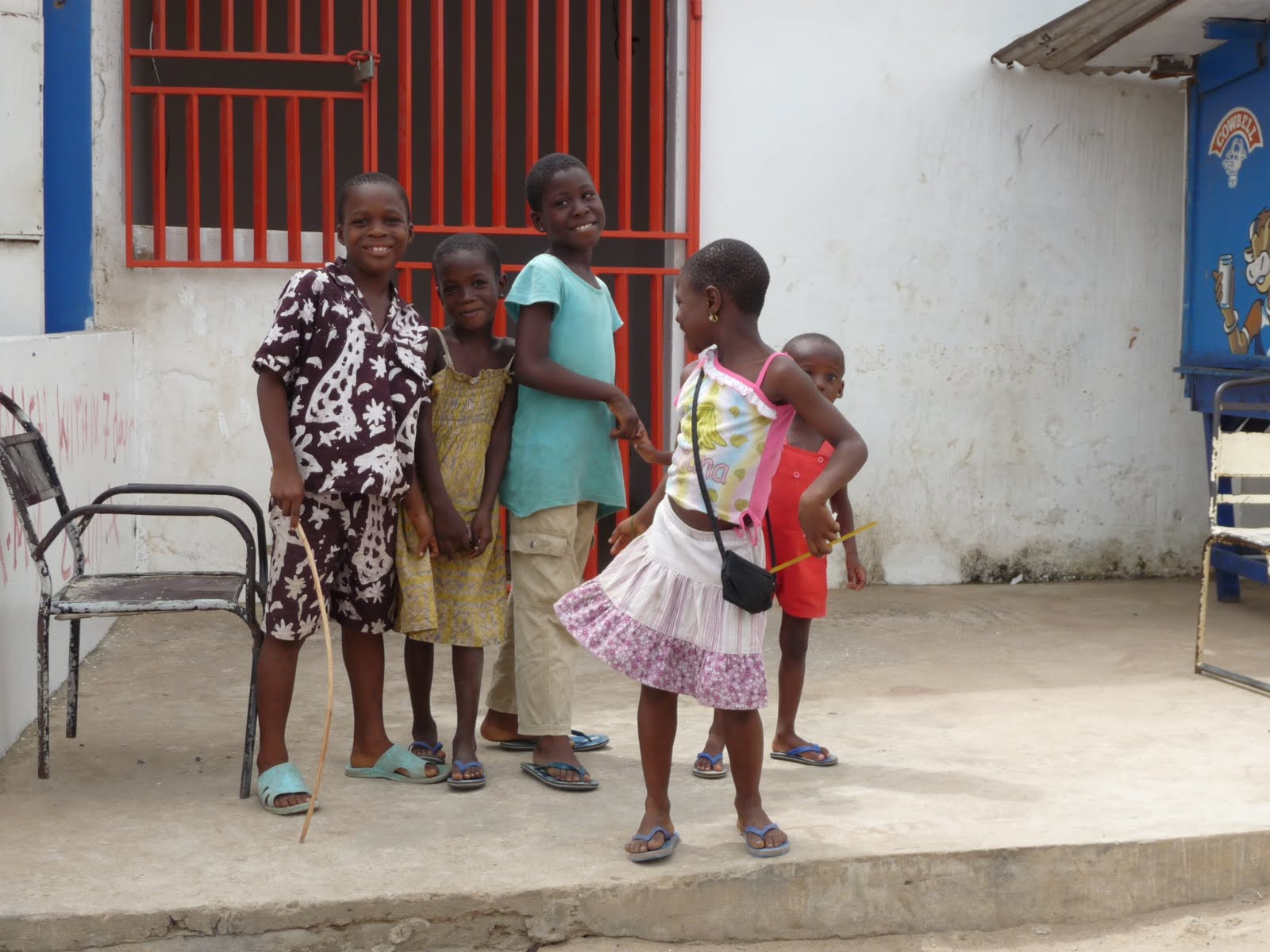
Sorry for the delay in getting last week’s blog posted. I had a busy weekend and couldn’t get my time and the internet to coincide. Some of the photos this week are random scenes from our travels. Such as this one of school girls on their way home.

A note about last week’s entry: Ben Markham, a West Africa veteran, pointed out to me that MAN trucks are a German made heavy duty truck. I’ve been watching for them all week. I found one near Tema on Saturday. He was right, it was a big truck. It was parked off the side of the road, so I couldn’t really tell if it was dependable or not. But now I know what to look for.


We passed the parked MAN truck on our way to the Cedi Bead Factory. We’ve been told that women from the states go home with suitcases of fabric and beads. We’re well on our way to a suitcase of fabric. But I doubt we’ll have a suitcase of beads. The factory is a family owned business that makes hand made beads from natural ingredients, primarily recycled colored glass. They grind the glass into powder and then layer the different colors of powder in clay moulds and fire the beads in an open brick oven.
The oven is made from clay retrieved from ant mounds.  All very fascinating. We watched the process from the grinding of the glass through the making and firing of the beads, to the polishing of the beads.  We had opportunity to purchase the beads,  on strands for bracelets and necklaces, or loose for do it yourself projects.  We purchased some bracelets and necklaces for gifts, but did not, by any means, fill a suitcase.  I suspect we’ll be back, however.  Marsha did purchase a very large necklace with 1 inch beads of clear turquoise that we want to frame as an art piece when we get home.  It is way too large and too heavy to wear but will be gorgeous framed with a linen back under glass in a dark wood frame. 


I met with a number of doctors this week.  The US Embassy hosts a monthly CME meeting for the local community of physicians on the first Wednesday of the month.  I went this week and got to meet the three physicians assigned to the embassy and a number of the Ghanaian physicians.  It was nice to meet some of the local physicians that I had heard of or read of their names in reference notebooks in the AMA office.  I visited two doctors in their offices on Thursday.  All have been very gracious and offered to help as need arises with the missionaries. 


On Sunday we went to church on the west side of Accra in an area called Buduburam.  It is the location of a refugee camp for victims of the civil war in Sierra Leone.  The experience was very humbling to meet members of the church who live in such poor circumstances.  There were a number of North American women at church who were working in the orphanage associated with the refugee camp.  The best I could tell from brief discussions with the women they were intending to adopt children from the orphanage.  I have mixed feelings about such efforts.  I am quickly coming to appreciate the fact that poverty does not equate with a disappointing life and living without material goods might actually be more fulfilling than living with abundance.   

The humor for the week:  We just had our first "spike boys" encounter.  We picked up the mission president and his wife from Lagos, Nigeria – President and Sister Neuder -- at the airport and didn't pull into the paid parking lot to do so.  I assumed that when the arriving passengers are standing on the curbside I could simply stop where the Neuders were standing, put their one bag into the trunk and drive away.  Stupid assumption!  The thugs were on me instantly, making me stop and putting this incredible medieval looking steel bar with three inch spikes projecting from the surface down in front of my tires.  I spent about five minutes arguing with them but convinced them to take pity on the poor stupid American missionaries who didn't know that all passenger pickups have to be through the paid lot, and that I would repent of my ways and never do it again.  And by the way "YOU ARE NOT A POLICEMAN, I'M NOT GOING TO PAY YOUR BRIBE, PLEASE MOVE YOUR SPIKES AWAY FROM MY CAR BEFORE I CALL THE REAL POLICE."  Maybe it was a Jedi mind trick, but they picked up the spike long enough for me to pull away.
Whew, we are not novices any more. The only thing left to experience is a mugging.  JUST KIDDING.  By the way, President Neuder  sat in the passenger seat during this whole experience and didn't say anything.  He has lived over ten years in Nigeria -- the corruption capital of the world.  He was probably disappointed in my performance.  I told him it was my first one and in the future I'll know my lines better. 


We send our love to all.  We are enjoying each day here and wouldn’t want to be any other place


Monday, March 1, 2010

Week #6


We met Dr. Emmanuel Kissi and his wife, Elizabeth, this week.  This is a picture of Elizabeth Kissi’s mother, who is 110 years old.  She is very alert.  She does not speak English but responded to all of our questions when interpreted by her daughter.   I cannot comprehend being 110 years old.  It doesn’t compute!


Dr. Kissi is a general surgeon who trained in Great Britain.  He and his wife joined the church in England and returned to Ghana in 1979.  He and his wife have been valuable members of the church serving faithfully in many capacities for all their years here at home.  Dr. Kissi has a hospital named Deseret Hospital.  He walked us through the facility, very proud of the facility he designed and built.  His daughter Elizabeth is a nurse practitioner who works as a midwife.  It is a very nice facility.


Six weeks ago, when we were being oriented, Dr. Stubbs indicated that, when driving, you need to make two assumptions:  #1, the brake lights on the car ahead of you are out, #2, every vehicle on the road, especially the trucks, is going to break down.  We have come to appreciate his wisdom.  More frequently than not the vehicle in front of us does not have brake lights.  We have learned not to look for them.  And whenever there is a traffic jam we have learned to look for the vehicle broken down that is blocking the road.  
Knowing this I have to share a funny incident last week.  Once or twice each week we drive the 25 km to the Missionary Training Center in Tema and back.   The drive takes only 15 minutes (once on the highway.)  It has become a game for us to keep track of the number of vehicles broken down on the side of the road.  Most of them are trucks.  The record, so far, is twenty six. Last week, while sailing along keeping track of the number of the vehicles on the shoulder we noted a large billboard announcing:  “FOR ALL YOUR HAULAGE NEEDS, DEPEND UPON MAN TRUCKS.”  We both cracked up.  First, the word "haulage."  I’ve never heard of “haulage.”  It must be a British leftover.  (I did find it in the dictionary; origin dates to early 1800's.)  Second.  MAN trucks.  What is a MAN truck?  Are there WOMAN trucks seeings that most of the women here carry a lot more on their heads than men do?  Or is a MAN truck a model, like a  KENWORTH truck?  We don't know.  But then to say “depend upon MAN trucks.”   I honestly don’t think there is a truck of any kind, MAN or not, here on the roads that I would depend upon. They all look like they are one day short of their breakdown date.  Maybe I just need to find a REAL MAN truck.  We'll keep looking.

As a compliment to Ghanaian ingenuity, however, when a truck is broken down, a tow truck isn't called.  The truck is repaired on the side of the road.  The Ghanaians fix broken drive lines, tires/wheels/suspension problems, engines, transmissions, etc.  I am amazed at how they can take a vehicle apart on the shoulder of the road, repair it, and get it on its way until its next breakdown. 

 
Back to the MTC.  This is a picture of Elder Fofana.  On Friday we went to the MTC to review the medical records of the new group of missionaries coming in.  This is a small group, about 26 total.  As we were checking them in we talked to one missionary from Sierra Leone named Joseph Fofana.  Marsha and I both looked at him and said, out loud, “What a coincidence, we knew a missionary in South Africa, Durban, two years ago named Joseph Fofana.”  (As explanation, Steve Mann, the mission president in Durban e-mailed us two years ago and asked us to “adopt” one of his missionaries who was spending his first Christmas from home and probably wouldn’t get anything from home for Christmas.  He was a survivor of the civil war in Sierra Leone and had to bury his father and a brother as casualties of the war.  We sent him a Christmas package and then communicated to him by e-mail during the remainder of his mission.  He has been home for about six months. We last exchanged e-mail messages about two months ago.)  This missionary at the MTC looked at us, thought about our question, and said, “he is my brother.”  It turns out all the boys in his family are named Joseph Fofana, each with a different middle name.  The missionary who served in Durban has a middle initial of “D.”  This new missionary has a middle initial of “A.”   

This second picture is a missionary who had his left arm amputated as a child.  He was in an altercation with some school kids who injured his arm enough that he had to have it amputated.  He is the dearest of young men.  Very sincere, and very smart. 

Marsha and I continue to enjoy ourselves.  We do not think about “home” now.  Accra has become our home.   We love what we are doing.  We love the people we are meeting.


Sunday, February 21, 2010

Week # 5

I had opportunity this week to meet Rebecca Tetteh.  I accompanied her to an appointment with an orthopedic surgeon in East Lagon, Ghana.   She is the girl with the crutches in the picture.  She is 10 years old.  Let me tell you about Rebecca.


Rebecca was born with bilateral dislocated hips (or hip dysplasia, I don’t know for certain which) and bilateral club feet.  To ambulate she had learned to pull herself along on all fours as a baboon would.  She would pull herself along to and from school each day, a distance of about half a mile.  She lives in Sotad village, about 50 kilometers from Accra.  


About three or four years ago a humanitarian missionary couple for the church discovered her in her village.  They arranged for her to be fit with a wheelchair through the LDS charities wheel chair program.   The care given her, however, did not stop with the wheelchair.   The humanitarian missionary couple, along with the medical advisor (same position I am now filling) started looking into other options that might be available to help her.  Over the course of a year these missionaries and the doctor arranged for her to be seen by orthopedic specialists that could surgically help her.  About two years ago she had her feet repaired and soft tissue contractures of her hips released.  When healed she was fit with shoes through the Orthopedic Training Center in Nsawam.  Crutches were made for by a volunteer here in Accra.  These pictures show her feet, before and after, and her standing for the first time, on crutches.   


Those that have helped Rebecca in the past continue wanting to help her.  Even though these loving people are back in the states they had arranged for Rebecca’s visit last Wednesday at an orthopedic clinic on the outskirts of Accra to be seen by one of the surgeons.  I was contacted and asked to help facilitate the visit.  Rebecca, her mother Roselin, and her brother Michael travelled by public transportation for two hours to get to the clinic in East Lagon.  I met them at the clinic.  Unfortunately, the doctor who examined Rebecca felt he had nothing further he could offer her in regards to her hips.  He suggested we see an orthopedic surgeon in the Brong Ahafo Region of Ghana who might be able to help.  This is not possible due to the difficulty of travel (about 8 hours distance from here).  We are all looking into other options, including evaluation and treatment in the states.  

I have been here five weeks now.   My frustrations with the medical system seemed to all collide with this little girl’s trip to East Lagon on Wednesday.  It took months to arrange the visit, all done through e-mails from the states.  When we checked in at 8:00 a.m. the receptionist told us we didn’t have an appointment.  When I produced copies of the e-mail correspondence she was able to miraculously find the appointment.  Even though the appointment was at 8:00 a.m. we waited approximately two hours to be seen.  The doctor did not seem very understanding of our desire to see what else could be done for this little girl.   I thought he dismissed our questions without much consideration.  I asked if his clinic would do x-ray films of her hips, pelvis, and LS spine.  He declined.  He suggested we see an orthopedic surgeon in the Brong Ahafo Region without giving any thought to the difficulty facing us in getting this girl there for evaluation.   I left the clinic quite upset.  And discouraged.  But Rebecca and her mother just smiled.  They seemed to have an abundance of the patience I was lacking.  They didn’t seem to be upset.  I drove them to the bus connection.   This little girl represents all that can be done to give compassionate, Christian, service to one in need.  One surgery has graduated her from baboon crawling to crutch walking.  Can we get another surgery, or two, to allow her to walk without crutches?  Pray for such a miracle.

I have been invited to meet again with Dr. E. D. Kitcher, head of the ENT department at Korle Bu.  I will meet with him tomorrow.  I’m hoping there might be a way to become involved with his training program. 

Last item:  two weeks ago I mentioned the upside down swivel desk chair.  This week it was the entire set of tables and bench chairs.  Only not on motorcycles.  I continue to be amazed at what these Ghanaians carry on their heads.


Monday, February 15, 2010

Week #4 -- "weatha" instead of "weather"


We’ve had a great week!  We got our satellite TV working.  We had to drive to the vendor about a mile away and pay for a month’s service, in cash, no checks or credit cards accepted.  It is Ghc $115, or about US $79, per month.  Stand in line and pay cash.  We’re going to keep it for a month and see if it is worth it.  For news we have a choice of the BBC, British CNN, British Sky News, and Al Jazeera.    We’ve been watching the news primarily on the stations from Great Britain.  When we get tired of the King’s English  -- “weatha” instead of “weather” --  we switch to Aljazeera and listen to English with an Arabic accent.   
 
In addition to leaving behind their language when they left, the British left behind a few other quirks.   We are actually not on the third floor of our apartment (as I reported last week.)  We are on the second floor.  The British call the first floor the ground floor and the second floor the first floor, etc.   All of the locks on the doors have to be turned around twice with the key to lock or unlock.   Our apartment is technically “flat 24.”  The electrical outlets are 220 volt with British plug pattern.  Each outlet has a rocker arm serving as a breaker.  We have an assortment of adaptors to fit all the different types of plugs on appliances.   The major bank is Barclay’s, a British bank.  But we drive on the right side of the road.  How did that happen?


We’ve become very bold this week, venturing out into other parts of the city.  On Thursday we walked about two miles to a grocery store and back.  On Saturday we drove to Osu, which is the “touristy” part of town.  Marsha purchased some fabric.  This is a picture of the “fabric store.”  I talked with David, a three year old, while Marsha was shopping.


 I have learned a lot about malaria this week.  We have had two missionaries very sick, VERY SICK.  One of them had a fever of 106 through the night and altered consciousness.   His fever would not come down with Tylenol and alcohol sponge bathing.  He was taken to the hospital in the morning and given IV artesunate which is curative.  He was improved within 4 hours of the medication.  The second one had been experiencing a week of headache and fever, not to 106, but above 101.  His CBC was reported as showing greater than 300 parasites per high power field.  I would have loved to see the peripheral smear.  I remember, vaguely, looking at prepared slides of malaria in medical school.  I would have found it very illuminating to be able to see this missionary’s peripheral smear firsthand.   His blood indices were also informative:  the white cell count was normal (not what I would have expected for such a fever) but the red blood cell count was a hemoglobin of 9, which is significantly anemic.  The anemia prompted me to read more about malaria.  Unbeknownst to me, a major cause of malaria death, especially in children, is the profound anemia caused by the intracellular parasites and the subsequent red blood cell hemolysis and secondary loss of oxygen carrying capacity.  When these missionaries are cured of the acute disease they are usually so wiped out they cannot function.  Now I know why.  They are anemic from the parasite hemolysis.  

We've been here an month, now.  Each day we see more of the beauty of this land and its people and less and less of what bothered us the first few days.   We love the kindness of the people.  We are beginning to see the profound photographic images all around us.  I regret not having a camera with a telephoto lens in order to shoot pictures from a distance so I would beel  feel that I am not intruding on these individuals' lives as much as I do with my little point and shoot.  I asked the woman in the first picture if I could take her picture and she was very hesitant.   After a moment she said something to me in Twi, and then turned to her side, which I assume was a consent to the picture.
 
This is a typical scene along the roadside.


Sunday, February 7, 2010

3rd week

I am mindless. I should have known that the winter Olympics wouldn’t start until after Super Bowel Sunday (which, by the way, is “live” here in the morning on cable TV.)  I have to apologize for joking about the Ghanaian winter Olympic team two weeks ago. Ghana actually has a downhill skier entered in the 2010 Winter Olympics. He “learned” skiing eight years ago in Britain. Everyone watch for him. He will probably rise to instant stardom just like Eddie the Eagle did in Ski Jumping a few Olympics ago.  I’ll still hold to my bets, though, that there will be no press coverage about the Olympics here. Sports involving snow are totally foreign to these people. The only way the Olympics would be televised here would be if Snow Soccer had become a new winter Olympics venue. Can you visualize Snow Soccer? I think the Olympic Committee ought to consider it. Can you see all the players wearing soccer shorts, knee high shin guards, and snow shoes? I'm sure it would be a lot more exciting than Curling.

I’m going to describe where we live but I need to start with some of the hilarity for the week. I don’t think I’ve mentioned the motorcyclists before. If I describe the drivers as CRAZY it requires, in fairness to the drivers, that I label the motoryclists as TOTALLY INSANE. Here are some of their rules (as I have observed): don’t wear a helmet, don’t stop at red lights, drive between the lanes of cars, and if that is not feasible, drive on the sidewalks. And the best one: on two lane streets it is easier to drive toward oncoming traffic until the very last minute and then pull back into the proper lane. I’ve had this happen twice, now, and both times I knew for sure that I was going to hit the motorcyclist head on.

Here’s the funny part. On our way home this week I looked in my rear view mirror and saw an upside down swivel desk chair coming up from behind me, in the space between my lane and the adjacent lane. In an instant a motorcyclist passed me, driving full speed and balancing this desk chair on his head. I watched him until he disappeared in the distance. The motorcyclist would lean to the right and left keeping this swivel chair balanced on his head while navigating his motorcycle through the traffic. It was a visual tour de force of athleticism. (and stupidity.)  Oh, to have had a video camera.


Marsha and I live on the third floor, thirty two steps up, in one of four buildings in a gated compound called Alema Court. Our kitchen window faces the east. About every other day, or every third day, we watch through our kitchen window the boys herd the cattle through the field. Normally, this scene would be considered very pastoral, except we are in the middle of a city of 2 million people. There is no pasture anywhere. This is a city. The field is filled with rubbish and trash everywhere. The cattle eat what little grass grows among the trash.


Our west window looks across the parking lot to another building. Just outside the window is a beautiful fan palm. I have observed that the fan palm has twenty four palms and as a new one starts to unfurl its leaves in the center an old one starts dropping off the bottom, on the side opposite to the new one. A new one has been unfurling since we arrived three weeks ago and the one dropping off is just almost to the ground. What a display of symmetry in nature. We have a little balcony off the living room. I’ve taken up jump roping for exercise on the balcony. After two weeks I have decided that jump roping is even more mindless than distance running. It is hard to think of anything while jump roping except when will this stupid exercise end. I’m trying to get a treadmill for our apartment. We’ll see how long it takes to get it here. I need something for exercising other than walking the 32 steps up to the apartment door once a day and jump roping on the balcony. (It is unfortunate that bicycling to/from work is totally out of the question. If the drivers didn’t kill you the motorcyclist probably would.  Killed by a flying swivel desk chair.)

We have a small swimming pool between two of the buildings.


It needs some cosmetic work on broken concrete, missing tiles, etc., but it functions quite well. Marsha is enjoying swimming laps 2 – 3 times a week. I’m trying to join her and swim laps, but as everyone in the family knows I don’t do well in water. It doesn’t come naturally to me. It is a little more cerebrally challenging than jumping rope, however. The nicest part of the pool is the landscaping. The bougainvillea covers the entry and a lot of the fencing. It is always in overwhelming pink and purple colors, just like it looks in Hawaii. There is a little grass area at the end of the pool with a couple of chaise lounges and chairs. There are several palm trees on the periphery of the grass and a lot of interspersed colorful vegetation which I cannot name but nonetheless admire. When lying on the chaise lounges one can watch the vultures flying overhead (from a distance they look like eagles.) I assume they are looking for their next meal. What else do vultures do when circling overhead?

Our apartment has a living room with a table for eating and two bedrooms, the second one serving as “computer central.” The apartment has two bathrooms. Marsha has the east bathroom and I have the west one. Don’t think we are being spoiled; both the bathrooms combined are smaller than our one at home. Were we to have to share one we would probably have to go to counseling to prevent spouse abuse.

The kitchen is small; I’m about two feet short of touching the two walls when I stand in the center and reach for the walls. We have an electric stove/oven and a microwave. We have a small refrigerator. And we have a small washing machine as well. (No dryer; if you want to dry your clothes in a machine you have to take the clothing to the adjacent building and use the one of two dryers which works. We have learned that the clothes dry just as well on a drying rack in the second bedroom.)  Marsha is getting pretty good at using the stove/oven and microwave. She made cookies this week.

We live five kilometers from work. I’ll describe work another time.

I’ve had a couple of challenging medical issues this week. One is a missionary in Nigeria that sounds like he is approaching schizophrenia (major delusions and disordered thinking.) We’re trying to intervene before it becomes a crisis. We’ve also had a missionary who had to be hospitalized for possible meningitis. I love the Africa shotgun treatment for high fever/headache/neckache/can’t touch chin to chest complaints: IV ceftriaxone (for meningitis) and oral artemether/lumefantrine (for malaria.) No lab tests, no spinal tap. And voila, the next day the missionary is better. We’ve been to the hospital two days to see him and take him food. (Food is not provided at hospitals here; families are responsible for feeding patients. Families also have to buy the patient’s medication and give it to the nurses to give to the patients. I think that President Obama should consider this as part of his healthcare reform legislation. It would save a ton of money.)


Love to all.